Monday, February 04, 2013
When Social Biz Meets Superbowl
I spend a lot of my time describing effective use of social media and the need for brands to have a real voice, to show that they are in touch with their customers, and to show that they are acting in real-time. Problems with auto-scheduling and then stepping away from social media content, or outsourcing social media tasks to inept firms, have time and again proven embarrassing (at best) for companies. But it's no reason to shy away from working in the social space.
Last night's power failure during the Superbowl brought several great examples of corporate social media voices in the right place at the right time, giving a bit of humanity to the companies and showing some personality behind the corporate image:
As with most anything else at work, it's a matter of hiring. Choose those who will understand and bring the right voice at the right time, who show a sense of humor and confidence in doing the right thing for the organization. And let them work.
Saturday, January 05, 2013
Happy New Year
It's my habit with each January column to revisit colums from the previous year. Here's a recap of major themes from 2012:
1. Find new approaches to design work
2. Be more reflective about practice, and work to evolve it
3. Find new ways to encourage change by showing value
The full piece is at:
http://www.learningsolutionsmag.com/articles/1082/nuts-and-bolts-happy-new-year-2013
Tuesday, December 04, 2012
Content Becomes Its Own Context
More: http://www.learningsolutionsmag.com/articles/1070/nuts-and-bolts-content-becomes-its-own-context
Tuesday, November 06, 2012
Metaphors
"How would different beliefs about learning affect our practice? What is the prevailing belief in your own work culture? In thinking of my own past and present workplaces, and the types of instruction I’ve most often been asked to build or facilitate, the belief seems most often to be that learning happens as people acquire discrete pieces of data—which we hope they’ll apply as needed. This in turn affects the way in which the instruction attempts to tap into prior learning and tie to other, related pieces of instruction."
For the full article, see: http://www.learningsolutionsmag.com/articles/1054/nuts-and-bolts-metaphors
The Pinterest board referenced in the article is at http://pinterest.com/janebozarth/learning-teaching-metaphors/
Tuesday, October 02, 2012
Assessing the Value of Online Interactions
In looking for value in online interactions, try to get past the idea of a magic metric. I can’t tell you that my spending x hours on LinkedIn and tweeting y times per day will get you the result I got in the example above. I can tell you that my choice of when, with whom, and how to engage is what helped drive that result.
For more, including an overview of a new framework from Wenger et al, see:
http://www.learningsolutionsmag.com/articles/1019/nuts-and-bolts-assessing-the-value-of-online-interactions
Tuesday, September 04, 2012
Unlearning
One of the givens in working with adult learners is the importance of helping them access prior knowledge and building on what they already know. But what if that prior knowledge is no longer useful, or the skills no longer applicable, or it was never very accurate in the first place?
See more in this month's "Nuts and Bolts" column: http://www.learningsolutionsmag.com/articles/1000/nuts-and-bolts-unlearning
Wednesday, August 15, 2012
Narrating Our Work
"By sharing what we are doing and how we are learning, we distribute the tacit knowledge otherwise so hard to capture; invite feedback and encouragement from others; invite others to learn with us; document our work and learning for future use; and tie our learning to the efforts of others. Here’s a true story about physical rehab turned learning turned hobby turned community of practice turned two successful businesses, all via informal, social means. And all within six months."
See this month's "Nuts & Bolts" column: http://www.learningsolutionmag.com/articles/984/nuts-and-bolts-narrating-our-work
Tuesday, May 01, 2012
"Selling It": Encouraging Change
This month's "Nuts and Bolts" column takes on a common problem: sometimes in our enthusiasm we may be creating the very resistance we're trying to overcome. "What we find cool, others find intimidating. What we find useful, others find threatening. What we find magical, others find scary. And sometimes the very benefits we tout are exactly what others fear."
Wednesday, April 18, 2012
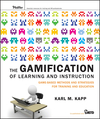
Blog Book Tour: Karl Kapp's "Gamification of Learning and Instruction"
Blog book tour stop 3: I was lucky enough to get my hands on an advance copy of Karl Kapp’s new book, “The Gamification of Learning and Instruction” (Pfeiffer) (also see the book's Facebook Page) just in time for a long plane ride. What a delight! In an age when there’s so much confusion about this in the field, Kapp offers a timely, common-sense view of realities and possibilities. Among my own frustrations are those in L&D (and, ahem, marketing) who are swept away on tides of badges and points without really understanding the instrinsic motivation and factors critical to successful, meaningful gamification. (More about that? Take a look at the incredibly popular new game Draw Something, in which the only "rule" is an implicit one and successful play requires collaboration, not competition. Fifty million downloads within 50 days of release. And there isn’t even a winner, ever. )
Kapp pitches the book at just the right level, making material relevant for more experienced gamers as well as for those to whom all this would be rather new. Several chapters offer basics about game elements and play, while others offer reviews of theory and research regarding games for learning, player types and patterns, and snapshots of ways games can support workplace performance of particular types of tasks. Chapters open with questions, which provides a nice advance organizer for the information to come.
This is an excellent resource for those seeking to make sense of the gamification craze and apply gamification principles to create better learning experiences.
Friday, April 06, 2012
How Can We Know What We Don't Know?
Last month's "Nuts and Bolts" column "Buy or Build? and hte decisionmaking folwchart included there, sparked an interesting comment from a reader: " Sometimes organizations go to great trouble and expense to build (often inferior) eLearning in-house becasue they don't really know what their other options are." I explore this further in this month's column: How Can We Know What We Don't Know?
Tuesday, March 06, 2012
eLearning: Buy or Build?
So often I see organizations struggling to develop eLearning in-house when, really, outsourcing would result in a better product that's really less expensive in the long run. This month's "Nuts and Bolts" column for Learning Solutions Magazine explores this: Buy or Build?
Saturday, March 03, 2012
What Does Learning Look Like? This.
3 Birds, One Stone
Bird 1: I do lots of workshops on using social media for learning, and I struggle to help participants see the possibilities of using images rather than text-based approaches in their work. Thanks to email and discussion boards, we tend to fall into "comment here, post there, respond to that" kinds of interactions. But now, with so many workers armed with cell phones, nearly all of which have decent cameras, there are so many more possibilities for using images and video in our work. A plus: This can level the playing field for people with low-literacy or second-language issues.
Bird 2: I struggle with helping learners recognize when they are learning. They think of it instead as "solving a problem" or "getting an answer". They don't say, "Gee, I'm a motivated, self-directed adult learner, and I think I'll become more mindful of that." They instead say, "I'll just Google 'spreadsheet tutorial' and see what I find." And if they don't recognize when they're learning, it may just not occur to them to share their new learning with others, or mention it to the boss, or include it in their weekly status report.
Bird 3: My whole career I have struggled to help managers and HR Directors and supervisors and workers understand that "learning" rarely looks like "school". Because of their experience with education, they believe learning happens at tables (or in front of a computer) while an expert talks.
One Stone:
This morning (thanks to Dan Pontefract @dpontefract sharing something via Valerie Irvine @_valeriei, who were posting this, the brainchild of Jeffery Heil
Fabulous answer to a fabulous question. And worth much more than 1,000 words.
Friday, March 02, 2012
From Traditional ID to ID 2.0
I have an article in the new issue of ASTD's T+D, "From Traditional Instruction to Instructional Design 2.0". It's excerpted here if you'd like to take look. Some highlights:
Social learning is learning with and from others by moving within one’s culture, workplace, and world. It’s often unconscious and unintentional, and it often looks more like solving a problem or working together to make sense of something. Social learning is how most of us learn most things: through living in our cultures and interacting with others there. It’s how babies learn to talk and how we learn the basic rules of getting along on the playground. It’s all around us every day, from water cooler conversations to asking a co-worker for an opinion.
What are some ways to help support the new learning as people work to implement it? Some ideas include
- an online leadership book club to sustain learning beyond the confines of the organization’s structured leadership academy
- a networking group for graduates of a particular course, which can be a great way to support transfer of new learning from the classroom event
- a dynamic, evolving frequently-asked-questions webpage for new hires, created by new hires, or a webpage with tips from top sales staff
- a wiki for group projects
- a site for “critical incident” discussions related to training topics such as customer service or ethics
- a microblog-based live chat for all the leaders in your organization, or all leaders in the pharmaceutical industry, or all leaders everywhere
- a Twitter hashtag assigned to your training sessions so participants can tweet key points and takeaways to those who were unable to attend.
Check here for the excerpt, and the actual publication for the full text.
Social Learning and Etc.: In Conversation with Jane Hart
Jane Hart and I got together to talk about social learning, social media, change management, and measuring engagement in online communities. Here's the recording: Her audio's not great so she let me do most of the talking. I didn't do anything to cause that-- I promise.
Tuesday, January 31, 2012
Not Everything Requires "Instruction"
New "Nuts & Bolts" column today: Watch for opportunities to quickly solve a performance problem or encourage use of a new idea, approach or tool. Warning: this may not have a thing to do with your job.
Wednesday, October 26, 2011
Headed to DevLearn?
I hope to see you at the eLearning Guild's DevLearn Conference and Expo next week. If you're there, join me Wednesday for a Morning Buzz session on social learning, on Thursday for breakout sessions "What Managers and Executives Need to Know About Social Learning" and, with Kevin Thorn "DesignBoarding: Leveraging Good Treatments for Your Content". Also on Thursday I'll be on the Strategic Buyers Stage to discuss "Outsourcing Social Media: When and Why". Also check out sessions from many of my great and learned (and entertaining) colleagues. DevLearn is always a great time, and this year it's in Vegas, baby. Should be a fun and meaningful time!
Thursday, October 06, 2011
"Nuts and Bolts" for Practitioners
Many of you likely know that for the past couple of years I've been writing a monthly column, "Nuts & Bolts", for the eLearning Guild's Learning Solutions Magazine. It's meant to help an audience largely made up of folks who may have found their way to eLearning and instructional design via less-than-formal means. I find that writing this often satisfies my bloggin' urge (and find that people often refer to these columns as "posts"). Some are ID based, some philosophical, some theory. Visit here for all the past columns.
"Social Media for Learning" Report
I was delighted that the eLearning Guild invited me to write up the results of their ongoing "Social Media for Learning" report. The 2011 version is now available to Guild members. Results showed great enthusiasm for using social media for learning, and widespread (83% of respondents!) belief that social media for learning was worthwhile.
There's a brief excerpt in my October "Nuts and Bolts" Column for Learning Solutions if you'd like to take a look there.
Tuesday, July 12, 2011
Tool Time: To Each His Own
In my work I sometimes need to schedule meetings with people, all at once, who live around the globe: New York, LA, Sydney, London. As I am math-challenged even on the best days I find the time zone issue confounding and almost always get something wrong. I'd tried a number of time zone converters but none displayed multiple cities in just the way I needed. So I was delighted to find out about World Time Buddy, which displays time by cities all at once. I tweeted about this and was almost immediately, resoundingly, hammered with responses like "this is not useful for webinars" and "I don't need to know the city, I need to know the time zone".
Here's the thing: World Time Buddy is useful to me. It is the tool that solves my problem. It is what I need. With literally dozens of time converters out there, no doubt there is something more useful for you, that solves your problem. This is part of the magic of the web 2.0 world: people can find just-in-time, just-for-me solutions. Some of us think that maybe that's supposed to be the point.
I see this happen, too, in discussions of most other tools. People say, "Well, college students don't use Twitter" as if there is some fatal flaw of Twitter that only college students see. Why would a college student use Twitter? Do most undergraduates need to reach out to big online communities day and night? I like Twitter because I am in a very isolating work role and have found it a wonderful way to connect with other L&D professionals and writers. I didn't really need that when I was in college. (And by the way: when I'm in a location with lots of friends nearby, like at a conference, and want to keep in touch via text, I don't really use Twitter for that. I like the Beluga phone app. I bet college students have something they like for that, too.)
And of course it is happening now with Google+. I keep going in to look at conversations, and I'd guess that fully half of them right now are either arguments about how Google+ is better or worse than some other tool, or discussions of which other tool will or will not be put out of business by Google+. I like Google+ fine, and I've enjoyed playing with it for the past week or so. I also still like Facebook and Twitter just fine, too. Others like LinkedIn. Or Ning groups. Or [name your tool]. (As I've said before: Don't like Facebook, Twitter, or Google+? Ask for your money back.)
I don't know why we feel there has to be one magic tool to rule them all. But I do know this, for sure: If tomorrow someone launched the Perfect Social Media Product, which was free, ridiculously easy to use, seamlessly integrated with every other need and tool, and solved every problem we had, then the day after tomorrow there would rise up a group of People Who Hate The Perfect Social Media Product. There would then be another tool, and more discussions, and ... will it ever end?
So my $.02? Find what you need, and use that tool/those tools. Partly that may be driven by where your best connections spend most of their time. But don't be blind to other, newer things, or places where other good connections are spending time, and try to give them an honest chance. And please, if we ever need to have a meeting in Yokohama, be sure to double-check my math.
Here's the thing: World Time Buddy is useful to me. It is the tool that solves my problem. It is what I need. With literally dozens of time converters out there, no doubt there is something more useful for you, that solves your problem. This is part of the magic of the web 2.0 world: people can find just-in-time, just-for-me solutions. Some of us think that maybe that's supposed to be the point.
I see this happen, too, in discussions of most other tools. People say, "Well, college students don't use Twitter" as if there is some fatal flaw of Twitter that only college students see. Why would a college student use Twitter? Do most undergraduates need to reach out to big online communities day and night? I like Twitter because I am in a very isolating work role and have found it a wonderful way to connect with other L&D professionals and writers. I didn't really need that when I was in college. (And by the way: when I'm in a location with lots of friends nearby, like at a conference, and want to keep in touch via text, I don't really use Twitter for that. I like the Beluga phone app. I bet college students have something they like for that, too.)
And of course it is happening now with Google+. I keep going in to look at conversations, and I'd guess that fully half of them right now are either arguments about how Google+ is better or worse than some other tool, or discussions of which other tool will or will not be put out of business by Google+. I like Google+ fine, and I've enjoyed playing with it for the past week or so. I also still like Facebook and Twitter just fine, too. Others like LinkedIn. Or Ning groups. Or [name your tool]. (As I've said before: Don't like Facebook, Twitter, or Google+? Ask for your money back.)
I don't know why we feel there has to be one magic tool to rule them all. But I do know this, for sure: If tomorrow someone launched the Perfect Social Media Product, which was free, ridiculously easy to use, seamlessly integrated with every other need and tool, and solved every problem we had, then the day after tomorrow there would rise up a group of People Who Hate The Perfect Social Media Product. There would then be another tool, and more discussions, and ... will it ever end?
So my $.02? Find what you need, and use that tool/those tools. Partly that may be driven by where your best connections spend most of their time. But don't be blind to other, newer things, or places where other good connections are spending time, and try to give them an honest chance. And please, if we ever need to have a meeting in Yokohama, be sure to double-check my math.
Thursday, July 07, 2011
Join me at eLearn Magazine!
I have recently taken on a new role as Editor in Chief of eLearn Magazine and hope you'll be a partner with me on this new journey. Here is part of my welcome message:
"I’m thrilled to be coming on board as Editor in Chief. We’ve worked hard to identify ways of keeping the best of the last 10 years while looking for new areas of focus and ideas for reaching a broader community of readers. eLearning has evolved so much since 2001, from “CBT” and the early days of “distance education,” through virtual classrooms and virtual worlds to, now, the brave new frontier of handheld devices and mLearning, in an age with so much being created, shared, and curated through the new channels provided by social media.
The eLearn reader we hope to reach is interested in and willing to use new technologies and approaches in creating, delivering, and supporting instruction (both academic and organizational) and workplace performance improvement. This reader sees him- or herself as an educator or workplace learning practitioner interested in professional development, improving practice, and learning more about learning regardless of the vehicle. He regards professional development and lifelong learning as an obligation for any practitioner in any field. She is not a schoolmarm with a ruler.
eLearn will continue to publish content for the higher ed audience but will expand material for those involved in workplace training, instructional design, and performance support. We’ve already begun this journey with Cammy Bean’s wonderful “Avoiding the Trap of Clicky-Clicky-Bling-Bling”, Aaron Silvers’ review of Thomas and Brown’s New Culture of Learning, and Tracy Parish’s reportage from Learning Solutions 2011."
We welcome reader submissions and invite case studies, research, app and product reviews, reviews of conferences and other events.
See the full text of my first blog post and writer's guidelines for more details.
Subscribe to:
Posts (Atom)