Wednesday, September 30, 2015

9 Critical Elements of Performance Improvement: Devlearn Session Recap

Session Recap:
“9 Critical Elements of Performance Improvement”
Devlearn 2015 Session 111: Jane Bozarth & Jeannette Campos


In January 2014 my husband, Kent,  was diagnosed with a brain tumor.  The experience -- from diagnosis to surgery to complications to recovery -- served as an excellent reminder that learning does not happen in a vacuum, that “training” is rarely enough, and that learners are actors in a system with many moving parts. This session explored 9 key points of performance improvement in the context of Kent's story.

1. “A problem well-stated is a problem half-solved.” ~Kettering
Kent presented with occasional blurry vision.  He thought he needed glasses. Our family doctor sent him to an opthalmologist. 

Discussion:
What evidence do we look for to confirm our understanding of the performance problem? How often do we treat symptoms versus performance problems?

2. Prepare your learner and others.
We were provided with only the most general information about what to expect from the surgery and during recovery.

Discussion:
How well do we prepare our learners for successful outcomes?  How often are our training interventions designed in response to specific and targeted performance problems?  How do we design for “personalized” learning experiences?

Do we even know who our learners are? What shortcuts do we take around getting to know our learners?

3. The long tail of performance improvement
We expected that Kent would return to work in about 6 weeks. It ended up being a year. 

Discussion: The long tail of performance improvement. Training has ended but the performance hasn’t yet begun.

How do we link/pair the training intervention with extended support for performance improvement?  Why is training (as an intervention) almost never enough?
How do we resist (or help others resist) the idea that the initial event – training – is the end when it is only the beginning?

 4. All learning is about relationships.
Performance depended on a network of support staff, from medical personnel to neighbors helping Kent take his first walks around the neighborhood.

Discussion:
When trainers/training aren’t enough (and they almost never are) … how do we think about the relationships that best support performance after learning? Well-designed performance improvement interventions involve many people from different parts/areas of the learner’s natural environment that exist well beyond the classroom. 
How do we as workplace learning practitioners design performance improvement strategies that extend beyond trainers and the classroom?
How do we promote learner-to-learner relationships? Or, said differently, how often do we involve a learner’s manager or co-workers in the success of a performance support intervention?   

5. Consider the five moments of learning need.
Unexpected outcomes forced Kent to have to learn new things, like managing with a walker and navigating a shower stall by palming the walls. 

Discussion:
This speaks to the classic five moments of learning need: When learning for the first time, when trying to remember, when trying to apply, when things change, and when things go wrong.

 6. “You and the cause of all of your problems are part of the same system.” ~Senge
Kent’s recovery depended on many moving parts, from transportation arrangements to visits to additional facilities such as outpatient PT office and the eye center.

Discussion:
What other parts of your system influence your ability to achieve optimal performance outcomes?  How do you incorporate  systems thinking into your design of training and learning events?

7. Allow for the graduation of a skill.
Time spent at inpatient rehabilitation involved hours of work toward successfully (without falling) showering, dressing, and performing basic life tasks. The facility had a working kitchen and things like freestanding steps and  a replica of a car that allowed practicing getting in and out.

Discussion:
The degree to which the learning environment replicates the performing environment.  How often are we able to do that in training?  How often do we try to do that in training?  What is the benefit of supported practice prior to application?

8. All people present with 4 basic tendencies
Based on the work by Chris Argyris, we know that all people present with four basic tendencies; 1) maximize winning and minimize losing, 2) remain in unilateral control, 3) appear rational, and 4) to suppress negative feelings. 

Discussion:
How much do you know about basic human behavior? How often do you think about predictable human behavior when you design, develop, and deliver training or learning interventions? 

9. What is measured matters.
The initial goal of “surviving the surgery” was a noble one but, given the outcomes, not enough. Given the complications many people in the system set other goals for Kent’s recovery.

Discussion:
What is a successful outcome of training? What is the goal of the intervention? How do we stay focused on the “true goal” of improved performance for our end-user instead of the artificial goal of “learning at training”.

I hope one thing people took away from this session is that "performance" is a concept far, far beyond someone completing an elearning course, passing a test, or even performing a discrete task correctly in the moment. There are 1,000 things between the learner and successful performance. The learner is an actor in a system and it's up to us to start seeing the nodes and connectors and other elements that will support performance improvement.

For more on Kent’s story see Bozarth, J. (2015). Performance Matters, or, Guy Walks Into A Brain Tumor Clinic. Learning Solutions Magazine June 2015. http://www.learningsolutionsmag.com/articles/1714/nuts-and-bolts-performan ce-matters-or-guy-walks-into-a-brain-tumor-clinic

Be sure to check out posts from all the DevLearn Bloggers! 


Update: Several hours after the presentation I received this from Kent: 


Keep Up with Your Conference Learning with this Template! (#devlearn)


Devlearn Bloggers Update: 

The September 24 #lrnchat focused on learning from conferences. Participant @MichelleOckers took away this idea for keeping up with conference learning. It’s a template she’s shared with us as a Google doc. Looks like a great tool, and I love the final colum's reminder to share learning with others. I hope  #devlearn folks find it useful.


(Don’t forget to join us for #lrnchat this week, coming LIVE to you from the Devlearn Demofest floor. Theme: Show Your Work, of course. Be prepared to share an example of something you do, something about your workday, even a photo of your office. See you then!  Thursday October 1, 8:30 pm ET, 5:30 pm PT. In Australia? That's Friday morning 10:30 AEST. Follow the @lrnchat account and use the #lrnchat tag.)

Elements of Working Out Loud at a Conference (#devlearn)

DevLearn Blogger Update:

Half the fun of a conference is participating in the backchannel, so friends back home, people who chose other sessions, and colleagues everywhere can keep up with the happenings. It's also a nice way of making notes for yourself. 

 Here’s Helen Blunden’s (@ActivateLearn) “Elements of Working Out Loud at a Conference”. Which ones will you try at #devlearn? 


Monday, September 28, 2015

The DevLearn Mobile App: A Lesson in Motivation and Reward (#devlearn)

One of the components of our upcoming Devlearn "Ukulele Learning" sessions is some conversation around motivation and reward.  A great example is happening right now in the DevLearn conference app, available to attendees. There's a swag shop with stuff like fun tshirts and sunglasses; app users can earn points toward purchases as outlined below. Notice the relative value of posting and filling out evaluations compared to just checking in or tagging something.
There aren't limits on what can be posted;  everything doesn't have to be "work related". Many posts are about sessions participants attended today; some are from presenters sharing tidbits from their upcoming presentations; some are pictures of the hotel pool, quick meetups, or pets and kids left at home. There's a lot of fun and engagement and people are making new friends. That's important when you're at a conference, especially alone, and helps to sustain engagement beyond the event. 

All behavior is purposeful. There's a great lesson here for those wanting to encourage use of collaboration tools and those who have goals like seeing more completed evaluation forms. I hope attendees recognize the app's activity feed as itself a valuable conference takeaway. 

Wednesday, September 16, 2015

Coming to Devlearn 2015?


Coming to DevLearn 2015? I'll be there with 2 new sessions and a refreshed visit to a fun one from last year.  Some prep has involved extensive new research. Some has involved rethinking something I may have changed my mind about. The best thing? Prepping for these sessions gives me a chance to collaborate with some of my best friends in this business, bright people who bring energy and passion and fun to creating something together.

1. First, with the ever-glamorous and wicked smaht Jeannette Campos, is "Designing for Performance: Nine Critical Elements" (Session 114, Wednesday Sept 30, 10:45 am). This one starts with the story of my husband's brain tumor -- my most-read written piece ever-- and our ensuing experience with the healthcare system. From there we'll look at critical learning elements, from the importance of a system view to the criticality of identifying the correct problem, and how we as learning practitioners can support the performer as an actor in a system, not just as a "learner" who takes a course or two.

2. Next, Shawn Rosler and Ellen Wagner join me for "Ukulele Learning: Exploring the Relationships Between Music and Learning" (Session 304, Wednesday, Sept 30, 3 pm; repeated on Thursday: Session 518, 1:15 pm).  Paralleling current trends, L&D has a lot of folks who've taken up the uke, and lots of them will be at DevLearn. Join us for an overview of how music can support learning, a discussion of ways to apply that to improve the experiences we design, and a short ukulele lesson that will have you playing a couple of songs in no time. There is rumor of an impromptu ukulele band jam after the Wednesday session so new players and singers will be welcome for that, too.

Kudos to the eLearning Guild for providing the ukuleles for this experience. After the conference they'll be donated to the Children's Hospital of Nevada UMC.

3. On Thursday, October 1 at 3 pm I'll be joining up with Cammy Bean, Jeannette Campos, and David Kelly for "Reignited: Meme-ing the Innovative World of Learning". Last year's experience with this was a riotous, provocative hour of poking at sacred cows and affirming a shared vision of what our field could be.

4. Even if you're not attending DevLearn, don't miss "#lrnchat LIVE!", which we do every year from the Demofest floor. (Thursday October 1, 8:30 pm ET, 5:30 pm PT.) #lrnchat is now in its seventh year. More than the average Twitter chat, #lrnchat's fun and spirit of community span time and space.

And don't miss other DevLearn highlights, with great keynotes from people like Mythbusters' Adam Savage, the Demofest experience, and a panel on gamification with Julie Dirksen, Koreen Pagano, Bianca Woods, and Sharon Boller. (Extra credit to the Guild for supporting women in games!)

Finally: I love that the eLearning Guild wants presenters to try new topics and new strategies. As a presenter at many of their events I love the conversations about how to put a new twist on a popular theme like social learning. I do hope "Ukulele Learning" grabs hold of a few new players for us to join up with at future Guild events. The eLearning Guild Futureama Uke Band has a nice ring, don't you think?

See you soon!


Friday, September 04, 2015

Social Media for Learning, Part 1: Extending, Including, Supporting


This month's Nuts and Bolts column is the first in a series updating ideas around using social media for learning. I'm looking especially at the rise of new tools for user-generated images and video:  

“L&D is great at creating and delivering content. But emerging and evolving tools give us the opportunity to engage with our learners in new ways, to help move us toward making workplace learning more a process and less an event. Consider where you have needs to extend the reach of a course, stay in touch with alumni or people in particular work areas or jobs. Chances are there are easy ways of solving a problem, enriching conversations, and making L&D’s work more visible and valuable.”

You can access the rest here


Tuesday, July 21, 2015

The #Blimage Challenge

I do love fun, original ideas. My buddy Jane Hart (@c4lpt) has just tagged me in the #blimage challenge. What is it? Steve Wheeler (@timbuckteeth) says: “You send an image or photograph to a colleague with the challenge that they have to write a learning related blog post based on it. Just make sure the images aren’t too rude. The permutations are blimmin’ endless.”  

Here's the image Jane sent: 


My first thought was that this is a wonderful metaphor for reaching for -- and finally getting to -- that ah-ha "lightbulb" moment that changes our perspective, or clarifies a concept, or illuminates an idea. The trees represent those around us -- those with whom we live and learn --  who one way or another help us reach that goal.

It's interesting that at nearly the same moment my #blimage assignment arrived another colleague pinged me with a question about PLNs. Another thing I see here, probably because of that conversation, is that in achieving this ah-ha several trees wrapped around and directly supported the tree reaching for it. Other trees stand close nearby, contributing in ways that may not be direct, but with roots touching and supporting below the surface, not serving only as onlookers. Such is the nature of social learning. 


See also my recent Learning Solutions Magazine piece on "Causing Serendipity" . 


And now... I hand the #blimage challenge off to David Kelly (@lnddave) Sue Beckingham (@suebecks), and Connie Malamed (@elearningcoach) . Here's your image:   


Be sure to check out this Pinterest board for results!


Thursday, July 16, 2015

Accessibility Is More Than "Compliance"

I'm always surprised that so many in the training/instructional design/elearning business aren't more concerned with accessibility issues. In my experience this comes more from lack of awareness than intentional disregard. Here are some musings on accessibility, usability, and universal design. Be sure to check the resources offered -- and don't miss the informative, helpful comments! 


Wednesday, July 01, 2015

About that Brain Tumor...

This month's column takes me into new personal-revelation territory with a story of terrifying surgery, recovery, and the ways training did (and didn't) play into it. Bottom line: Performers are actors in a system. The things L&D so often focus on don't happen in isolation. 


Tuesday, May 05, 2015

Causing Serendipty

In my social media workshops I find that participants struggle most with ideas for supporting serendipitous, accidental, and spinoff learning. This month's Nuts & Bolt's column offers tips for that.  Among them? Be a curator & connector, encourage reflection, and put rocks in the path. We can’t schedule accidents. But we can work to help create an environment in which opportunities can serendipitously occur.


Sunday, April 12, 2015

A Spring Treat: Connie Malamed's New "Visual Design Solutions"

Much better than a hollow chocolate bunny, my metaphorical Easter basket this year held a review copy of Connie Malamed’s wonderful new Visual Design Solutions: Principles and Creative Inspiration for Learning.  


As a career-long government employee I’m always interested in low-cost solutions so appreciate Connie’s attention to the idea that good design is not necessarily about money or software. She offers  examples created with PowerPoint, tips for taking your own photographs, and ideas for making something better by, for instance, mixing photographs for a more complete effect. My other career challenge, again a product of my government environment, is the unending demand for learning experiences around deadly-dry-content areas like policy and compliance. Malamed helps here, too, with ideas for making content more exciting and offering suggestions for challenges like working with numbers. Some other highlights:

-          Visual fluency and the role of symbol in developing a common language
-          Overcoming simple challenges that often bedevil new designers, like working with gradient backgrounds
Alternatives to bullets and other layout challenges
Grouping to support the brain's gift for pattern sensing 
-          Techniques for creating emphasis   

If there’s a central message, though, it’s the idea of designing with intention. As I like to say in one of my own design workshops: “Put your hands in the air and step away from the computer.” Think about the look and feel and the feeling and the view from 10,000 feet. What is the whole experience you’re after? It is hard, looking at an authoring tool, to refrain from wanting to start loading content and searching for templates and images. Malamed wants the learner to have an elegant, complete experience. To that end she focuses on the view of a project as more than the sum of its parts. Typeface matters: Even people not trained in design “pick up cues from a typeface and ascribe its characteristics to a personality” and are aware when the typeface doesn’t match the message.  Color matters: It conveys mood and stirs emotions, especially pleasure. The palette has psychological impact.  The tone of the writing matters. The choice of when and how to, or not to, use white space matters. In other words: Everything matters.

Malamed’s Visual Design Solutions is an excellent resource useful for anyone in the training/elearning design/presentation business but also anyone involved in design in general and communication in particular.  


Sunday, March 08, 2015

What's the Story in the Slide Deck?

This month's Nuts & Bolts column looks to extend Cammy Bean's great session on writing better elearning scripts.  Key ideas include trimming the fat, editing ruthlessly, finding your 20%, and playing the old "classified ads" game.   Check it out!

Monday, February 09, 2015

Cammy Bean, "Writing Better eLearning Scripts" Training 2015

I'm in Atlanta for Training 2015. Our friend Cammy Bean so often live blogs other people's conference sessions, including some of mine, I figured I'd return the favor.

"How can we write better programs?" 

-Aim for short & snappy
-How do people talk to each other? Write like that. Use a lighter, accessible tone.
It's really critical to know your audience
(Form follows function) Comic books are fun and can support the fun affect.

-We are storytellers - that's why writing is so essential.
"It's all about the people, man. Sitting at the other end of that computer is a person. We need to make it accessible, conversational. What if you were sitting having a cup of coffee with someone and talking about this topic? Capture that tone.

-Object to learning objectives. These are objectives for the designer. Learners don't need these and won't read them -- and it's not how we  talk to each other.  (Jane: I have never had a boss ask me to "list" anything.)

- Read it out loud. Would YOU want to listen? That helps a lot with cutting jargon, wordiness. Make it something that's appealing to you. If you think it's boring, others will think it's even more boring.

- Inject humanity by letting real people talk. Use iPhones if you need to: "Here's what  I think." "Here's my perspective" "Here's how I do that." Work out loud/show your work.

- Tell great stories. See Heath & Heath's Making Things Stick . Use stories to help someone step into another's shoes. It will help them remember, will help with subsequent practice.

- Grab attention w tales of risk & intrigue. Provide a cliffhanger. Set up a curiosity gap.

- Find stories by asking questions of SMEs: Where do people get this wrong? What do people want to DO? Where can they get more information and help?

-"Ask your experts to think out loud. Get them to narrate their work and walk you through the process."

-"Have the SME tell you the story of their slide deck."

-Use the words they SAY, not the words they write. Get it in their words.

- Activate your writing -- go for engaging, active. Pull the learner through a great story. Connect the dots so the story flows from one piece to the next.

- Cut the blather; focus on doing.

- Write the neverending story. Elearning may just be the beginning -- help learners take the action out into the real world.

-Clear call to action: get them to think about how they will change their behavior.

Learn more at cammybean.kineo.com. Today's slide deck is available on Slideshare.


Tuesday, December 02, 2014

Expand Your Surface Area


In this month's Nuts & Bolts column I extend an invitation to  expand your surface area beyond usual topics and readings and communities:
 
" A while back at an eLearning Guild event (DevLearn 2010), I was fortunate to attend a keynote by John Seely Brown, who at the time had just published his 
Power of Pull. Among my takeaways? His advice to “expand your surface area.” One great way to do this is to increase your nonfiction reading, or join in conversations, in areas perhaps not directly connected to your immediate work interests."


Take a look! 

Monday, November 10, 2014

Figure It Out

No time or money to do what you'd like? Not "allowed" to use this tool or that process? Shifting time constraints? This month's Nuts & Bolts column explores figuring things out, making things happen, and getting things done. Largely inspired by Euan Semple who said: “Quit reading case study porn and get on with it.”

Wednesday, August 06, 2014

"Social Media for Learning" meets "Show Your Work": The 21 Day Drawing Challenge

There's a fun social learning activity going on via Lynda.com., the "21 Day Drawing Challenge" . Led by artist Von Glitschka, the project offers a daily new assignment (like "draw a cat" or "draw a man on a unicycle using only a continuous line") along with a quick overview video and printable reference worksheet. 

Additional support and participant interaction happen via a Facebook page.  There Von Glitschka offers additional tips and sometimes directs participants to tutorials in other courses. Even better: People use the comments area on the daily Facebook posts to share pictures of their own drawings and to talk about what they found especially challenging or describe the technique they used. It's a great example of people interacting around a shared purpose, showing their work, helping each other learn.

Many people are also sharing their images via Twitter (#draw21days); @
kristinrtaylor tweeted a picture and said: "My first go at @lynda #draw21days challenge. Getting over my fear of others seeing my work. Have to start somewhere!" 

So if you're interested in using social media to support instruction, and/or seeing how "show your work" really works (or if you're interested in learning to draw!) do pop by and take a look. Day 3 has just started so there's still time to catch up if you'd like to join the fun. 


Tuesday, July 29, 2014

Reflective Practice

. Consider investing more time in working toward improving in the future, reconcilin
We spend a lot of time in this business talking about how to do things: build it, program it, deliver it, launch it, or sell it. We don’t spend much thinking about what to do after we’ve actually done it. Consider investing more time in working toward improving in the future, reconciling your walk with your talk, and building your role as practitioner in a professional pursuit.

See the July Nuts & Bolts column for details on becoming a more reflective practitioner. 

Monday, May 12, 2014

Show Your Work!

We know that a lot of “traditional” knowledge management approaches don’t work very well. We have piles of status reports and documented standard operating procedures and what have you, and still, data says we spend a quarter of our time looking for something—or someone—with the information we really need.

Working efficiently and effectively isn’t just about capturing “information.” We need to do better, not at documenting what people do, but how they get things done. This will help our organizations, our coworkers, and others who engage in our practice. It will support your credibility and establish or strengthen your brand. And it’s how we help each other learn.

See this month's Learning Solutions Nuts & Bolts Column offers an exploration of how showing our work can help solve some of organizational life's most bedeviling problems. 

Available now! 


Tuesday, March 11, 2014

Managing Expectations of Social Tools


I find that many organizations have rather unrealistic expectations of what will happen when they move to employ social tools. See this month's Nuts & Bolts column for more: "Every member in an organization won’t participate equally. There will be noise. And some of that noise will end up having value, or building a bridge that will prove useful later. Just like in real life.”

Headed to Learning Solutions next week? I've got breakouts...stage presentations...a panel... and live #lrnchat! Hope to see you there. 


Monday, February 10, 2014

Building Community

A lot of my time is spent hearing about, and talking about, and reading about, and endeavoring to, building communities.  I find that people come to the conversations often too focused on the same things (mostly control, platforms, and, er, control) without much regard to desired outcomes, user experience, and dangers. See this month's Nuts and Bolts column for more.  

Tuesday, October 01, 2013

Punish the Learner

For those who've been keeping up with Project Ukulele, I found a nice local group that has a uke playalong meetup every 1st and 3rd Monday. We meet in a small coffeehouse that hosts small concerts so there's something of a 'stage' up front.  In months that have a 5th Monday -- like September 2013 -- there's an open mic meeting. People come prepared to perform a song or 2,  and with the smaller group that shows up it's a fun time to share and learn some new songs. 

Last night as we were winding down, and after a good deal of nudging from the man next to her, a woman named Vivian got up on stage. She's been playing for 2 1/2 weeks. Weeks. Before she began she said:

"I took piano lessons for a year when I was six. The night of my recital I walked out on stage in my beautiful blue satin gown my grandmother made for the occasion. We weren't allowed to have music; we were expected to play our pieces by heart. I sat down on the bench and started to play and then -- I couldn't remember what came next. I just froze. And I hung my head. And I remember now how it felt when I looked down and saw big teardrops falling down onto my beautiful new satin dress. I haven't touched an instrument since then."


She put some printed music on a stand, then played and sang a lovely rendition of Leonard Cohen's "Hallelujah". 

In my work I run into a lot of "blame the learner" mentality: "They can't use the technology, and they don't want to learn, and they don't care, and no matter how many times we go over it they go back to work and do it wrong."  And I recently read -- really --  "There are no learning problems in corporate settings. There are only people unwilling to learn." 

I promise you no one wanted to learn more than 6 year old Vivian. But put a good performer in a bad system and the system will win every time. 

Let's talk about Vivian. She was 6 years old and:
Was expected to perform.
Before she was ready.
In an unnatural setting.

In public.
With "bosses" watching.
By memory.
Without a job aid. 


I suppose you get my point. 

Last  night Vivian was ready to try again. It wasn't quite this, but it wasn't bad at all. And it only took her 56 years. 


Tuesday, September 17, 2013

Making Video More "Social"

Something new next week, hosted by KZO Innovations: Video used in formal training, or to support informal learning, doesn't have to be just another passive viewing experience.  Too often online video becomes just another publish-only venture, but there are easy ways to make it more of a social and reflective endeavor. Join me for a look at the ways video can be used effectively to extend learning experieces and help generate new ones. September 26, 1:30 pm, free (note: 50 minutes). Sign up


Monday, September 02, 2013

The Myth of Best Practices: Update

In 2009 I wrote a post, "The Myth of Best Practices"  , that described problems with both context and fidelity. Here's a great example of what usually happens when "best practices" are transferred from one setting to another: 


Wednesday, August 28, 2013

Be A Learner


This month's "Nuts and Bolts" column explores the ways an instructional designer can learn from her own learning. In my line of work there’s a lot of conversation about instructional design and common design flaws, and I spend a lot of time evaluating eLearning courses and products. I find it helps my perspective immensely when I set out to learn something new for myself, the more unrelated to work, the better. Among them: Play the song, draw a picture, and lose the ferrets. 

See more at http://www.learningsolutionsmag.com/articles/1218/nuts-and-bolts-instructional-design-101be-a-learner . 


Tuesday, June 11, 2013

"Show Your Work" Event Today


I publish a lot, and few things have gotten me more response than last August's Nuts & Bolts column, "Narrating Our Work". It clearly resonated with readers, so much so that strangers now contact me wanting to share their own examples. (I am always interested in seeing more, by the way.)


As I wrote in the May issue of T+D Magazine:
" Sharing and showing what we’re doing and learning can ease several pain points for organizations. First there’s the capture of tacit knowledge:  it helps fill the gap that so often occurs when someone leaves a job but those remaining don’t know how to pick up where the former worker left off. And it helps others learn about executing work not easily captured as a step-by-step process. Then there’s the matter of connecting talent pools, branching across organizational silos, and surfacing expertise. How many times have you finished a project , or researched an idea, or hunted down a resource, only to find someone else had already done the same thing? For T & D, a willingness to learn from what workers share can help to reveal where training issues exist, provide artifacts that can be repurposed as training content, and help make workplace training more relevant and real-world based.  And:  showing what we’re doing -- narrating our work in a public way -- work helps make learning more explicit. It surfaces informal and social learning to help make it visible to the organization and and management, whereas often now it is only opaque." 


Join me today, June 11, 2 pm ET,  for "Show Your Work", a webcast hosted by ASTD. We'll look at a lot of real examples and talk about why, how, who, and what we in L&D can do to support it. The session is free but you do need to jump through some registration hoops.


Curious? Here's a Pinterest board that should give you an idea of the kinds of things we'll discuss today. 

Friday, May 24, 2013

Are You a Positive Deviant? (Updated June 1)


Update: I curated some resources for webinar attendees that others may find interesting. Due to the buzz this topic generated we're continuing the conversation in #lrnchat on Thursday, June 6, 8:30 pm ET, 5:30 PT. (Sydney? That's Friday June 7, 11:30 am.) 

"In every group there are a minority of people who find better solutions to the challenges at hand…even though they have access to exactly the same resources as the rest of the group, their uncommon practices or behaviors allow them to flourish.”—Jerry Sternin


You know one: the one manager of 30 in the building who never misses deadlines and consistently shows good results while retaining great staff. The one teacher who’s successful with technology integration, while 50 others don’t “have time.” The one state government classroom trainer of 500 who instead of saying, “We can’t do e-learning because it’s too expensive,” asked, “How can we do e-learning without much money?” 
Read the rest in this month's issue of Training Magazine.

And view the recording of the May 29 webinar (Training Magazine Network)  "Tips for the Positive Deviant"  . 

Thursday, April 04, 2013

Want Better Outcomes? Design Assessments First


New Learning Solutions column this week: “Work backwards. Write the performance goals, decide how you will assess those, and then design the program. The content and activities you create should support eventual achievement of those goals.”ork b

See the full article at:


http://www.learningsolutionsmag.com/articles/1146/nuts-and-bolts-design-assessments-first

Sunday, March 31, 2013

What is "Good" eLearning, Anyway?

This month in Learning Solutions:

"Over the years I’ve seen a lot of lists of criteria for buying eLearning, for developing a product, and for choosing a vendor or developer. I agree we have to go in having some idea of what ‘good’ is, at least enough to keep us away from all text or bedtime-reading narration of that text, or seductive but irrelevant elements. The trick? Finding an explicit performance need, getting clear on assessments first, and sticking to a plan that helps the learner learn.”

See more at: 
http://www.learningsolutionsmag.com/articles/1115/nuts-and-bolts-what-is-good-elearning-anyway

Sunday, March 03, 2013

PowerPoint Converter for 2013


With the 2nd edition of Better Than Bullet Points: Creating Engaging eLearning with PowerPoint (updated for PowerPoint 2013) going to press in August I’ve been busy learning PowerPoint 2013 and testing out converter tools. [Disclosure: I made it known that I was working on this. Some vendors approached me asking me to test tools; I downloaded some free trials of others.] What I’ve always needed? Quick conversion, quick upload with minimal bugs, and fidelity in capturing audio, transitions and animations, including triggers.  What I need now? All of that, compatible with PowerPoint 2013, and with reliable conversion to both Flash and HTML5.  And, with Microsoft’s unfortunate decision to take the Sound Editor out of Windows, I hoped for a product that included an audio editor, thereby keeping me to just two tools (PowerPoint and the converter tool) rather than three or more.

I looked at several products and found overall I was very happy with the iSpring Suite 6.2 and still-in-beta iSpring Pro 7. http://www.ispringsolutions.com .  I gave it quite a workout and consistently got the fast, smooth conversions I was after without once having to go play with manifest files or otherwise do any debugging.  Conversion of even big slide shows with lots of images, animation and audio is very fast. I don’t make heavy use of video but did try conversions with several video clips in assorted formats and got good results. Here's the iSpring Suite toolbar: 


The player is highly customizable.  I never need 1/10 of what most products offer so it did everything I wanted although I admit to not pushing it very hard. I especially liked the ease of making choices:  unlike some other products, there aren’t a lot of default settings that are difficult to override. 


Publishing is a one-click to web, cd or LMS, and everything ran the first time, every time. I was pleased with the audio recording and editing tools and allow that it is much better than the minimal functiontonality provided by the old Windows Sound Editor.

While I’m not looking for much in the way of “authoring” outside of PowerPoint itself, the iSpring suite includes the Quizmaker and the Kinetics interaction tools so I did take them for a spin.  The Quizmaker provides options to create graded items such as multiple choice, matching, hotspot, and even text entry, or ungraded survey-style quizzes.  The Kinetics tool is limited but offers a few interactions, such as one for creating a page-flip appearance, a FAQs creator, and a nice little timeline builder (period, event, that sort of thing)  that would be tedious to build from scratch in PowerPoint. 

Overall: The product behaves well, did what I need without compromise or workaround, and had no performance problems during testing. There are a few animations not yet working with PowerPoint 2013 but they are expected in an upcoming update. I’m not one to often endorse products but, along with my undying love for SnagIt, can say iSpring is worth a look.  There’s a free trial for iSpring 6.2, but I’m bringing this conversation up now because iSpring Pro 7 is currently in beta  and available to those wishing to serve as testers. See http://www.ispringsolutions.com/ispring-pro-7.

Monday, February 04, 2013

When Social Biz Meets Superbowl


I spend a lot of my time describing effective use of social media and the need for brands to have a real voice, to show that they are in touch with their customers, and to show that they are acting in real-time. Problems with auto-scheduling and then stepping away from social media content, or outsourcing social media tasks to inept firms, have time and again proven embarrassing (at best) for companies. But it's no reason to shy away from working in the social space. 

Last night's power failure during the Superbowl brought several great examples of corporate social media voices in the right place at the right time, giving a bit of humanity to the companies and showing some personality behind the corporate image: 


As with most anything else at work, it's a matter of hiring. Choose those who will understand and bring the right voice at the right time, who show a sense of humor and confidence in doing the right thing for the organization. And let them work. 

Saturday, January 05, 2013

Happy New Year


It's my habit with each January column to revisit colums from the previous year. Here's a recap of major themes from 2012:

1. Find new approaches to design work

2. Be more reflective about practice, and work to evolve it 
3. Find new ways to encourage change by showing value

The full piece is at: 

http://www.learningsolutionsmag.com/articles/1082/nuts-and-bolts-happy-new-year-2013

Tuesday, December 04, 2012

Content Becomes Its Own Context


“How much of our training budget goes to things that have nothing to do with ‘learning’? Why does the LMS cost more than the whole L&D department? How many organizations invest in more authoring tools and asset libraries than they do in people who know how to use them to design more effectively? Why have we fragmented learning into shards of ‘objects’ rather than craft whole, robust learning experiences? We’re supposed to be in the learning business, not the ‘object’ business.”

More: http://www.learningsolutionsmag.com/articles/1070/nuts-and-bolts-content-becomes-its-own-context

Tuesday, November 06, 2012

Metaphors


"How would different beliefs about learning affect our practice? What is the prevailing belief in your own work culture? In thinking of my own past and present workplaces, and the types of instruction I’ve most often been asked to build or facilitate, the belief seems most often to be that learning happens as people acquire discrete pieces of data—which we hope they’ll apply as needed. This in turn affects the way in which the instruction attempts to tap into prior learning and tie to other, related pieces of instruction."

For the full article, see: http://www.learningsolutionsmag.com/articles/1054/nuts-and-bolts-metaphors

The Pinterest board referenced in the article is at http://pinterest.com/janebozarth/learning-teaching-metaphors/

Tuesday, October 02, 2012

Assessing the Value of Online Interactions


In looking for value in online interactions, try to get past the idea of a magic metric. I can’t tell you that my spending x hours on LinkedIn and tweeting y times per day will get you the result I got in the example above. I can tell you that my choice of when, with whom, and how to engage is what helped drive that result.

For more, including an overview of a new framework from Wenger et al, see: 
http://www.learningsolutionsmag.com/articles/1019/nuts-and-bolts-assessing-the-value-of-online-interactions

Tuesday, September 04, 2012

Unlearning


One of the givens in working with adult learners is the importance of helping them access prior knowledge and building on what they already know. But what if that prior knowledge is no longer useful, or the skills no longer applicable, or it was never very accurate in the first place? 

See more in this month's "Nuts and Bolts" column: http://www.learningsolutionsmag.com/articles/1000/nuts-and-bolts-unlearning

Wednesday, August 15, 2012

Narrating Our Work

"By sharing what we are doing and how we are learning, we distribute the tacit knowledge otherwise so hard to capture; invite feedback and encouragement from others; invite others to learn with us; document our work and learning for future use; and tie our learning to the efforts of others. Here’s a true story about physical rehab turned learning turned hobby turned community of practice turned two successful businesses, all via informal, social means. And all within six months."  

See this month's "Nuts & Bolts" column:  http://www.learningsolutionmag.com/articles/984/nuts-and-bolts-narrating-our-work

Tuesday, May 01, 2012

"Selling It": Encouraging Change

This month's "Nuts and Bolts" column takes on a common problem: sometimes in our enthusiasm we may be creating the very resistance we're trying to overcome. "What we find cool, others find intimidating. What we find useful, others find threatening. What we find magical, others find scary. And sometimes the very benefits we tout are exactly what others fear." 

Wednesday, April 18, 2012

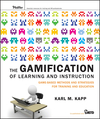
Blog Book Tour: Karl Kapp's "Gamification of Learning and Instruction"

Blog book tour stop 3: I was lucky enough to get my hands on an advance copy of Karl Kapp’s new book, “The Gamification of Learning and Instruction” (Pfeiffer) (also see the book's Facebook Pagejust in time for a long plane ride. What a delight! In an age when there’s so much confusion about this in the field, Kapp offers a timely, common-sense view of realities and possibilities.  Among my own frustrations are those in L&D (and, ahem, marketing) who are swept away on tides of badges and points without really understanding the instrinsic motivation and factors critical to successful, meaningful gamification.  (More about that? Take a look at the incredibly popular new game Draw Something, in which the only "rule" is an implicit one and successful play requires collaboration, not competition. Fifty million downloads within 50 days of release. And there isn’t even a winner, ever. )

Kapp pitches the book at just the right level, making material relevant for more experienced gamers as well as for those to whom all this would be rather new.  Several chapters offer basics about game elements and play, while others offer reviews of theory and research regarding games for learning, player types and patterns, and snapshots of ways games can support workplace performance of particular types of tasks. Chapters open with  questions, which provides a nice advance organizer for the information to come.

The author has called in some big guns in terms of expertise, with Alicia Sanchez providing a chapter-length case study from Defense Acquisition University, and a chapter on virtual reality games from expert Koreen Olbrish.   I love that Chapter 11 is written by high school senior Nathan Kapp, the author’s son, who  brings a particularly relevant perspective as  he “has been playing video games his whole life."

This is an excellent resource for those seeking to make sense of the gamification craze and apply gamification principles to create better learning experiences. 


Friday, April 06, 2012

How Can We Know What We Don't Know?

Last month's "Nuts and Bolts" column "Buy or Build? and hte decisionmaking folwchart included there, sparked an interesting comment from a reader: " Sometimes organizations go to great trouble and expense to build (often inferior) eLearning in-house becasue they don't really know what their other options are." I explore this further in this month's column:   How Can We Know What We Don't Know? 

Tuesday, March 06, 2012

eLearning: Buy or Build?

So often I see organizations struggling to develop eLearning in-house when, really, outsourcing would result in  a better product that's really less expensive in the long run. This month's "Nuts and Bolts" column for Learning Solutions Magazine explores this: Buy or Build? 

Saturday, March 03, 2012

What Does Learning Look Like? This.

3 Birds, One Stone


Bird 1: I do lots of workshops on using social media for learning, and I struggle to help participants see the possibilities of using images rather than text-based approaches in their work. Thanks to email and discussion boards, we tend to fall into "comment here, post there, respond to that" kinds of interactions. But now, with so many workers armed with cell phones, nearly all of which have decent cameras, there are so many more possibilities for using images and video in our work. A plus: This can level the playing field for people with low-literacy or second-language issues.


Bird 2: I struggle with helping learners recognize when they are learning. They think of it instead as "solving a problem" or "getting an answer". They don't say, "Gee, I'm a motivated, self-directed adult learner, and I think I'll become more mindful of that." They instead say, "I'll just Google 'spreadsheet tutorial' and see what I find." And if they don't recognize when they're learning, it may just not occur to them to share their new learning with others, or mention it to the boss, or include it in their weekly status report. 


Bird 3: My whole career I have struggled to help managers and HR Directors and supervisors and workers understand that "learning" rarely looks like "school". Because of their experience with education, they believe learning happens at tables (or in front of a computer) while an expert talks. 


One Stone: 
This morning (thanks to Dan Pontefract @dpontefract sharing something via Valerie Irvine @_valeriei, who were posting this, the brainchild of Jeffery Heil  -- that's how Twitter works, see?) I ran across the most wonderful big stone that hits squarely on all 3 birds: being mindful about learning, while showing what it really looks like, all done via sharing photos on Pinterest on a board called "What Does Learning Look Like?"  


Fabulous answer to a fabulous question. And worth much more than 1,000 words. 


Friday, March 02, 2012

From Traditional ID to ID 2.0

I have an article in the new issue of ASTD's T+D, "From Traditional Instruction to Instructional Design 2.0". It's excerpted here if you'd like to take  look. Some highlights:


Social learning is learning with and from others by moving within one’s culture, workplace, and world. It’s often unconscious and unintentional, and it often looks more like solving a problem or working together to make sense of something. Social learning is how most of us learn most things: through living in our cultures and interacting with others there. It’s how babies learn to talk and how we learn the basic rules of getting along on the playground. It’s all around us every day, from water cooler conversations to asking a co-worker for an opinion.

What are some ways to help support the new learning as people work to implement it? Some ideas include
  • an online leadership book club to sustain learning beyond the confines of the organization’s structured leadership academy
  • a networking group for graduates of a particular course, which can be a great way to support transfer of new learning from the classroom event
  • a dynamic, evolving frequently-asked-questions webpage for new hires, created by new hires, or a webpage with tips from top sales staff
  • a wiki for group projects
  • a site for “critical incident” discussions related to training topics such as customer service or ethics
  • a microblog-based live chat for all the leaders in your organization, or all leaders in the pharmaceutical industry, or all leaders everywhere
  • a Twitter hashtag assigned to your training sessions so participants can tweet key points and takeaways to those who were unable to attend.
Check here for the excerpt, and the actual publication for the full text. 

Social Learning and Etc.: In Conversation with Jane Hart

Jane Hart and I got together to talk about social learning, social media, change management, and measuring engagement in online communities. Here's the recording: Her audio's not great so she let me do most of the talking. I didn't do anything to cause that-- I promise.

Tuesday, January 31, 2012

Not Everything Requires "Instruction"

New "Nuts & Bolts" column today: Watch for opportunities to quickly solve a performance problem or encourage use of a new idea, approach or tool. Warning: this may not have a thing to do with your job.