Thursday, September 10, 2020

What Works - and What Doesn't - In Diversity Training

 Organizations implement diversity initiatives for a number of reasons, including a desire to increase representation, decrease workplace conflicts, and teach different individuals how to work together effectively.

This new research report from The Learning Guild, What Works, and What Doesn’t, in Diversity Trainingassesses literature on diversity training, outlining key points and offers insight into which strategies lead to either the success or failure. You will get a glimpse into the benefits of developing a successful diversity training program within your organization, which approaches you should consider when planning your efforts, and which tactics you should avoid.

The report is available for free with a free membership to The Learning Guild


Thursday, August 06, 2020

Evidence-Based Design for Virtual Classroom Experiences

In watching events of 2020 unfold I've seen many organizations make a sudden shift from face-to-face training to the virtual classroom. There's lots of talk about the technology -- security concerns, the unending challenges of the mute button, even how to create Zoom backgrounds -- but I see much less about ways of making the actual instruction better. 

In the August research report from The Learning Guild I offer some suggestions for this based on some sound principles for design as well as suggestions for helping facilitators sharpen their skills, or develop new ones, for the new environment.  Evidence-Based Design for Virtual Classroom Experiences  is available for free download with a free membership to The Learning Guild. 


Thursday, May 14, 2020

Less Content, More Learner: An Overview of Learning Experience Design (LxD)

This month's research report from The Learning Guild is Less Content, More Learner: An Overview of Learning Experience Design (LxD)Where traditional approaches to workplace learning tend to focus on building knowledge and/or skills, learning experience design is concerned with additional areas, such as shoring up learner confidence and increasing motivation to learn. This new report provides an overview of this exciting approach to workplace learning and suggestions for mapping learner experiences and journeys. 

This report is available for free with a free membership to The Learning Guild. 


Saturday, April 18, 2020

Designing for Behavior Change: A Conversation with Julie Dirksen

In this video research report, Julie Dirksen provides an in-depth look at Susan Michie et al.’s research on how to understand and support behavior change to improve job performance. Dirksen shares common problems that arise when designing learning experiences for changing behaviors and explores how you can use the Susan Michie et al.’s COM-B model to find solutions.  The report can be accessed via a free membership to The Learning Guild. 


Friday, January 17, 2020

More Similar than Different: What the Research Says About Generations in the Workplace


The topic of “generations” in the workplace has become popular among L&D professionals. Stereotypes exist regarding generational differences surrounding values, work behaviors, and preferences in supervision. These perceived differences impact the modern workplace in everything from hiring practices to office design. This new report from The Learning Guild uses academic literature and empirical research to analyze whether these generational differences are as important as people believe them to be and provides recommendations for handling these differences moving forward. More Similar than Different: What the Research Says About Generations in the Workplace is available for free download with a free membership to The Learning Guild. 


Saturday, October 19, 2019

Let Me Google That for You (LMGTFY)


Let Me Google That for You (LMGTFY), just out from The Learning Guild, gives me the opportunity to respond to Guild member questions that require answers but not full-length reports. Does everybody really have a mobile phone? What is the optimal length for a training video? Does eLearning really save time? These are just a few of the questions that Jane Bozarth is frequently asked by Guild members and L&D professionals. In Let Me Google That for You (LMGTFY), she shares her responses to these questions and gives insight on topics that range from definitions to instructional design terms to references on empirical data regarding the effectiveness of eLearning.


The report can be downloaded for free with a free membership to The Learning Guild. 


Tuesday, May 21, 2019

I'M NOT A BLOGPORTUNIST

There's really no blog post here. I'm not one of those people who pretend to engage in Twitter conversations while only looking for ways to spam everyone with an old post. Worst offenders: The ones who manipulate a conversation around to an excuse to blogdrop. 

Urban Dictionary: Blogportunist: "Someone, who in the midst of an online conversation, shares one of their own blog posts usually in an effort to show how smart they are or let people know they’ve already had this idea or as a form of self promotion (marketing)."

Saturday, October 27, 2018

Tracy Parish: Actual Rockstar


I'm just home from DevLearn, always a fun, exciting event. This year was especially meaningful for me as I watched one of my best friends, Tracy Parish, achieve well-deserved stardom as she won not just the annual shirt design contest but also the top prize in the 71-entry Demofest event, "Best Mobile Solution" category.


I'm guessing I've known Tracy for upwards of a decade, first online as #lrnchat participants (we're both moderators now) and later as conference buddies. In that time I've watched her emerge as a leader in our industry, offering practical real-world help for those working on limited budgets through her dazzling aggregation of low-cost tools and products, to helping lead the Toronto Storyline user community, to helping run the Canadian eLearning Conference. She's a stellar example of a pragmatic practitioner, always happy to help and to show and share her work. It has been fun and energizing watching her evolution and I think I was as thrilled as she was when she took the stage to receive her award.

Here's one of my own favorite photos, taken the day we snuck away from a conference to visit the Wizarding World of Harry Potter.  I love Tracy dearly, and am proud of her both as a colleague and a friend. I look forward to seeing what she does next.


Saturday, June 16, 2018

iSpring 9! Lots of New Features

I always enjoy hearing from my friends at iSpring, who apart from being excellent humans with a great product are fun companions at minigolf. So I was delighted to get an email asking me to take a look at the newest release, iSpring9. 

Usually when a tool gets a refresh there are a few updates, but this new version of iSpring has advanced the product by leaps and bounds.  My three favorite changes:

1. New Video Editor

In this release iSpring greatly expanded the capability of the earlier, basic iSpring Cam. The newly-renamed iSpring Cam Pro includes a video editor that provides annotation/captioning as well as robust features such as adding in other video and audio elements, so you could have, say, timed text steps or a talking head video alongside an animation. 

2. LOTS more Interactions
This release offers a much-larger array of 12 interactions, including easy-to-animate charts. 
I was always a fan of iSpring's "timeline" interaction and am pleased to see the accordion available now as well.  


3. Drag and Drop! 
The iSpring quizzing tool goes to the next level with drag and drop capability. Honestly, I'm amazed whenever I play with these tools now: I remember 100 years ago (when we had to do web design by candlelight :-) )  when it took half a day and an instruction manual for me to code a drag and drop by hand in Dreamweaver. It feels almost magical to be able to do it now in a matter of minutes. 


Well, those are my favorite new features. Everything has more options that I haven't outlined here, from annotation and transparency setting on the videos to choices of how you work with the interactions and quiz types.

If you haven't yet checked out iSpring9 I encourage you to go download the trial and see what might let you check something off your own wishlist. 

Friday, May 11, 2018

Blended Learning in Practice

This month's research report comes from Insync Training's Jennifer Hofmann: 

Blended learning can be applied in a variety of ways. This report examines some common critical success factors for incorporating blended learning into organizational training and offers recommendations for a successful move towards blending learning.

Blended Learning in Practice, by Jennifer Hofmann, explores data collected in interviews with organizations in order to answer the question: How are blended learning programs being implemented, and what are the associated benefits and risks?

View the executive summary and download the report here

Friday, March 23, 2018

Social Tools for Learning: Updated Report for 2018

Social tools have emerged, disappeared, and evolved over time. The question is whether or not these tools are being used successfully in the modern L&D landscape. Are organizations leveraging social tools to support training and performance efforts today?

Earlier this year The eLearning Guild conducted a survey with its members on the topic of social tools. Using Social Tools for Learning, by Jane Bozarth, delves into the data collected from the survey and shares key findings. Access the executive summary and full report here

Thursday, March 15, 2018

Crash Course for New Instructional Designers

Classroom trainers are often recruited to create eLearning content that is nothing more than a regurgitation of classroom materials. There are lots of reasons why this happens: Managers who don’t understand that “training” involves more than just presenting content; purchasers who believe an authoring tool will allow any user to magically crank out gorgeous, interactive programs; well-meaning classroom trainers who perhaps lack a background in design or have trouble making the leap from face-to-face to multimedia approaches; companies that can’t invest in external products or developers; and individuals who just won’t say, “No.” Whatever the reason, it happens. Often. This month in Learning Solutions I offer ideas for a "crash course" in learning design for those who may find themselves thrown into the role. https://www.learningsolutionsmag.com/articles/nuts-and-bolts-crash-course-for-new-elearning-designers

Monday, March 12, 2018

What's Your Reality? AR and VR

The eLearning Guild's April research report examines the benefits and barriers of using augmented reality and virtual reality in organizations and how these organizations access and utilize the data derived from the AR and VR systems.

The eLearning Guild conducted a survey with its members on the topic of augmented reality and virtual reality. What’s Your Reality? AR and VR for Learning, by Jane Bozarth, explores the data collected from the survey and shares key findings. In the report, find action items on how you can get started.

See more at: https://www.elearningguild.com/insights/221/blended-learning-in-practice

Monday, February 12, 2018

Creating Significant Learning Experiences

This month in Learning Solutions I take a look at Dee Fink's Five Principles of Good Course design. 
A “good course” is one which meets the following five criteria:
1. Challenges learners to higher-level learning
2. Uses active forms of learning
3. Gives frequent and immediate feedback to students on the quality of their learning
4. Uses a structured sequence of different learning activities
5. Has a fair system for assessing learning
Fink also offers ideas for taking a more expansive view of our work and beginning with the end in mind. 

The items are explained in more depth in the column proper. See https://www.learningsolutionsmag.com/articles/2568/nuts-and-bolts-creating-significant-learning-experiences

Sunday, December 03, 2017

New Job!


I'm very excited about my new role and, after more than 2 decades in government, am looking forward to exploring the mythical private sector. Watch for monthly research reports and more starting in early 2018. 

Tuesday, November 14, 2017

eLearning on a Shoestring

This month's Learning Solutions column revisits a favorite topic of mine: Working with very little budget.
For years, it seems that everyone in our field has been looking for ways to produce eLearning on a shoestring. In fact, my debut as a voice in the L&D industry came with publication of my first book, eLearning Solutions on a Shoestring, back in 2005. (Note: DO NOT buy a copy! It’s still available here and there and is woefully out of date. Feel free to buy any of my other books, though…) While so many great new inexpensive tools, open-source resources, creative design techniques, and friendlier pricing models have emerged, a few things seem to remain constant.


  • Not understanding the reality of development
  • Not knowing what you already have
  • The tech that will "change training forever!"
  • Cart before the horse 


For more, see the rest of the column at https://www.learningsolutionsmag.com/articles/2513/nuts-and-bolts-elearning-on-a-shoestring

Thursday, November 09, 2017

Monday, July 03, 2017

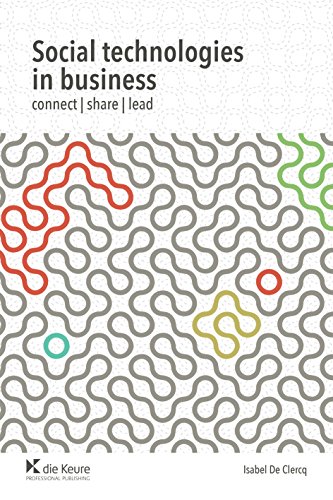
"Social Technologies in Business"

Know what happens when a bunch of your friends get together and assemble the best compilation ever of thinking in the social-social media-collaborative learning-knowledge management-narrating work realms? This book.


My interest in social learning and working out loud grew from my own wonderful experience as a participant in a vibrant community of practice. We mentored one another, shared what we learned, and even took turns demonstrating new ideas and skills in order to get feedback about how to make them better. We found ways of circumventing silos and transferring tacit knowledge, problems our employing organizations had struggled with for years. The burning question remains: How do we help all workers, and their organizations, reap the benefits of such sharing and support?

De Clercq and her team come at this with multiple perspectives and real-world experience. Those needing an introduction or a good amalgamation will find it here, in clear, concise writing organized in easily-digestible bits. Social Technologies in Business offers something for everyone: answers to objections, ideas for getting started, a review of tools, methods for implementation, case studies with “stealable” concepts.  I especially appreciate the realistic view: there’s honest discussion about barriers and failure factors, warnings about things not to do, and the reality of endeavoring to engage in enterprise-wide anything. This is an excellent resource for those hoping to influence and maybe even help transform their organizations. And the host of contributing voices, including Simon Terry,  Paul Miller, and Mathias Vermeulen, is credible.  De Clercq holds a special place in my heart for sharing my own opposition to Digital Detox. (Well, that, and the fact that she has publicly referred to me as “the Pippi Longstocking of L&D”, as there is no greater compliment.)

Some key takeaways?
-Don’t blame technology
-Have a strategy
-Being social is a mindset, not a tool
-Don’t start by fighting
-Less is more: As Charles Jennings has noted, the point is to extract learning from work, not impose more work


Beautifully designed and eminently readable, Social Technologies in Business is a winner for those seeking to understand and implement use of social tools and approaches in their practice and their workplaces. 

Monday, May 15, 2017

Designing for Learner Success: First, Do No Harm


eLearning designers and developers spend a lot of time on assessments, particularly things like quizzes and knowledge checks and tests. It’s easy to fall into blame-the-learner mode when they don’t do well: I often hear everything from “they aren’t paying attention” and “they allow distractions like email and phones” to “no one reads anything.” But sometimes, easily fixed design issues are the culprits. Some things to look at are overload and extraneous information, the dreaded "wall of words", wrong information (yes, really), and the one-size-fits-all approach. See this month's Learning Solutions column for details. 


Monday, March 06, 2017

Maker Party! Show Your Work


so this happened the night of March 4. We were looking for a way to bring our more interesting friends together so hit on this:   
                   
                Kent & Kelly: Birthday Twins!
A party with a twist: Makers only! We’re inviting friends who create: tie-dyers, artists, writers, musicians, welders, woodworkers, those who have started businesses. People with a passion or interest they have put into practice. 

             PLEASE bring something for show and tell (and to sell, if you like). Just bring some samples of your work, or something to perform, and tell us something about it: why it's a passion, how you do it, what you wish others knew about it, how you learned it, whatever. Nothing formal. 

       Speaking of Making: This will be a GRILLED CHEESE EXTRAVAGANZA with a make-your-own bar to exceed your wildest dreams. Come hungry! 
I've done a lot with ideas around working out loud over the years and if there’s one thing I’ve learned it’s that people love to talk about their work. Not their jobs, necessarily, but their work. But “What do you do?” is not a good question. Better? “Tell us about something you love about your work, or a hobby to which you’ve devoted a lot of time and energy:  How do you do what you do? How did you learn to do it? What was the biggest obstacle?” 
Everyone had a different approach to what they wanted to share.

Process: “It puts me in a flow state.” We had a wonderful opening 10-minute-ish presentation from a friend whose tie dye hobby has turned into a cottage business. Supplementing her talk with samples, she gave us a fascinating look at her process, from creating new designs to blending colors to a new interest in the ice dying technique that produces gorgeous watercolor-esque effects. https://www.facebook.com/FlowExperienceTieDyes/   


Interest: It’s a response to an industry problem. Wendy Gates Corbett talked more about her impetus and outcomes.  In response to so much bad PowerPoint in our business (L&D) she started Refresher Training LLC. Wendy takes slide decks and other training resources and reworks them into more engaging, effective materials. Check her site for great before-and-after examples. 


Go where the questions are; be open to showing the work people want to see: My Gang of Ukes bandmate Mitchell kindly came to sing with me but had a couple other things to offer. After years of working for other people he quit his job last week and on Saturday opened Performance Print Services, a digital printing company here in Durham NC. It was fun to hear about someone launching a lifelong dream, but the group kept getting sidetracked with questions about a gift Mitchell brought: A dozen beautiful eggs from his girlfriend’s brood of chickens. People had lots of questions for him. My 2 takeaways: Chickens that lay colored eggs lay the same color all their lives. And newly laid, unwashed eggs are coated with “bloom” that keeps them fresh without refrigeration.


Life Shift Drives Work. Sterling Fulton talked about the career path that led her to write her values-based life planning guide; she’s also behind the new site and events for Love in Action, designed to help overcome "isms". Her partner Dana Wallace Gower is also an author specializing in a faith-based view of career management. 


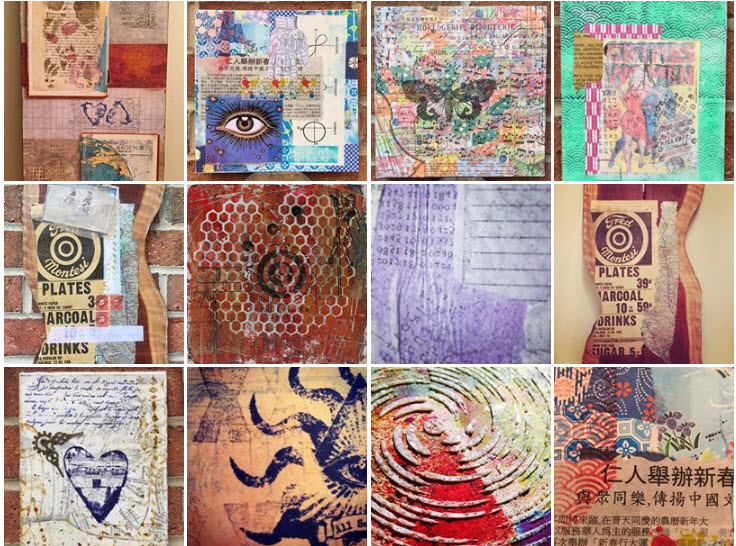
Lifelong Learning Path. Artist Michael Snipes (right) shared his learning path, including bartering work product for painting lessons, while Cipher Art’s Kelly Johnston talked more about process and how she works with collages to build a narrative. One thing she had to work through: a confidence problem fed by her lack of formal training.  


Her samples (below) included some work with her artistic collaborator, graphic artist Sarah Beard.  
Sarah works full-time as a packaging designer but in her spare time does a bit of other work as Cornbread Creative – lately a t-shirt-a-day project, with proceeds going to different causes -- as well as some work with Kelly.  We also heard from a friend who does gorgeous woodworking, another who discussed her interest in modern culture and political activism, and another who manages a local brewpub.   
Among the takeaways here: the local community college has resources available to artists and hobbyists, including wood lathes and glass blowing and pottery kilns.

Another takeaway: Of the people who offer online resources and samples, there was far more use of Facebook and Instagram than traditional websites.


Bunny Ears.  The evening closed with a friend’s child, Grace (age "five and two-thirds"),  who “plans on building a home for homeless people and needs to learn how to get money to help people.” She asked if she might share something with the group and showed us what she learned that day: How to tie her shoes. (Photo below by Sarah Beard.)  Then everyone had birthday cake and ice cream while Mitchell and I played “I Wanna Be Sedated” and “The Time Warp” on our ukuleles. 

The Makers party went even better than I’d hoped.  Talk was lively and happy; those who brought items for sale ended up as often as not bartering for an item with someone else. Many people found additional areas for connection or people with similar values or political interests. It turned out Kristi’s political activism dovetailed with things Sterling is working on. Sarah’s mom once raised the same kind of chickens as Mitchell’s girlfriend. Wendy and Sterling already knew each other, which I didn’t know. Sarah and Kelly had once met Linda and Heath, and their dog Dottie, at the pub Ari runs. 

I’d organized the party as a Facebook Event, which provides a separate Facebook page with space for guests to post and comment, and people are still talking about the party and to each other today. I didn’t really do a formal presentation about my work but reiterated what I said above: People love to talk about their work, and being enthusiastic and excited to show it off is interesting to others, too. Give people time and space for it, let them choose aspects they want to discuss, and ask questions besides, “So where do you work?”

We had a great night and if the idea appeals to you I’d say go for it. Some advice? 

  • Party-wise this was excellent. People were at ease, there was a lot of non-awkward non-forced conversation, and some did a bit of business or made good connections. Many found other shared areas of interest or other links.
  • It wasn’t really planned this way but 10 short (5 to 10 minute) presentations, with a dinner break, was just about enough, and took us from 6 pm to 11ish.   So I'd say don't go bigger than 10 couples. 
  • Mix it up! Don't just choose people from your own line of work. Bringing in people with eclectic interests helps everyone expand their surface area. 
  •  Everything is better with grilled cheese.  And a corgi.


Grace & Mitchell: