With many innovations, the end users ultimately take the wheel. One of my pet interests is classroom trainer fears of e-learning, and I've been saying forever, or at least since 2001 (which is almost forever in e-learning years), that eventually the learners would start to drive. This week's Time magazine has a piece on "Daddy Boot Camp" for new fathers that includes this:
"...enrollment in childbirth classes has fallen from 70% of first-timers in 2002 to 56% in 2006--with the drop-off due in part to expectant couples' assuming they can learn just as much from books or online."
Several things here: Learners are recognizing that they can be self-directed and self-taught. The learner assumption that this can be learned via books or online won't change--we're there. So we'd better be sure the e-learning is good.
Monday, June 09, 2008


Monday, June 02, 2008
When to Use Video
Karl Kapp, Susan Boyd and I are in Philadelphia this week providing the ID Institute for the Society for Technical Communication Summit. I'm in the back of the room now while Karl's presenting his session on choosing instructional strategies. He just said something great about when and how to use video, and I think it's worth sharing:
"If the only thing moving is somebody's lips, then you don't need video."
"If the only thing moving is somebody's lips, then you don't need video."
Saturday, April 26, 2008
"Heat"
Greetings from Sint Maarten, where I've spent the past couple of days in the sun reading (appropriately, as this is the island of high temps and fine dining) Bill Buford's Heat. Like Atul Gawande's wonderful Complications, Heat is an interesting first-person account of how an adult learns. Those interested in adult learning, reflective practice, self-directed learning, the transfer of tacit knowledge, or communities of practice will likely find this a worthwhile read.
Tuesday, April 01, 2008
New ID book ships next week!

My new big red (very red) book ships next week, chock-full of tools, templates, checklists, worksheets, guidelines, tips, rants (well, only on problems with evaluation and "ROI"), most of them also available as printable/editable items on the CD.
The long list of contributors reads like a who's-who in contemporary training, including folks like Karl Kapp, Jennifer Hofmann, Jean Barbazette, Don Clark, Patti Shank, and Ruth Clark, and includes some lesser-known trainers with good stuff to share. Check out the searchable version on Amazon: From Analysis to Evaluation: Tools, Tips, and Techniques for Trainers .
Thursday, March 27, 2008
Musings about level 1 evaluation....
While I'm not much of a fan of Level I evaluation, I do think it can shed insight into the effectiveness of our programs if we ask the right questions and pay attention to the answers. I'm dealing with metrics-fans right now who want to ask smile-sheet questions like, "On a scale of 1 to 6, did you find the training useful? ..." What am I supposed to do with knowing that people ranked the training as an average of 5.9 in 'usefulness'? Or worse, a 2.6?
Here's an evaluation Kassy LaBorie and I did yesterday in the wrap up to our online "Games Synchronous Trainers Play" session. (See citation at the bottom of this post). It tells us much more than the typical "smile sheet"

What can I tell from this? That we emphasized the right things; that our points were clear; that we met our objectives; that we have provided people with tools (games) they feel they can integrate into their own synchronous programs. Next go round we may emphasize even more the need to incorporate games as they relate to content, not just as filler, I also see that we may have given the wrong impression about something: there's a comment in the lower right quadrant about self-paced learning, which we didn't discuss at all and certainly weren't casting aspersions toward. (Heck, I'd rather access the worst self-paced program than most lecture-based 'webinars' any day!)
And what else does it tell us? Well, for those who believe that the online experience suffers due to lack of eye contact and body language, look at this screen again: are people interested and engaged? Do I really need traditional "eye contact" to tell me that?
If you must undertake Level I evaluation, try to find something that will give you more meaningful information than "4.5" ratings with no explanation. And pay attention to the feedback!
What other ideas do you have for evaluating at this level?
Evaluation activity submtted by Michele St. Pierre; adapted from an activity in Pike & Solem's 50 Creative Training Closers (Pfeiffer, 1998).
Here's an evaluation Kassy LaBorie and I did yesterday in the wrap up to our online "Games Synchronous Trainers Play" session. (See citation at the bottom of this post). It tells us much more than the typical "smile sheet"

What can I tell from this? That we emphasized the right things; that our points were clear; that we met our objectives; that we have provided people with tools (games) they feel they can integrate into their own synchronous programs. Next go round we may emphasize even more the need to incorporate games as they relate to content, not just as filler, I also see that we may have given the wrong impression about something: there's a comment in the lower right quadrant about self-paced learning, which we didn't discuss at all and certainly weren't casting aspersions toward. (Heck, I'd rather access the worst self-paced program than most lecture-based 'webinars' any day!)
And what else does it tell us? Well, for those who believe that the online experience suffers due to lack of eye contact and body language, look at this screen again: are people interested and engaged? Do I really need traditional "eye contact" to tell me that?
If you must undertake Level I evaluation, try to find something that will give you more meaningful information than "4.5" ratings with no explanation. And pay attention to the feedback!
What other ideas do you have for evaluating at this level?
Evaluation activity submtted by Michele St. Pierre; adapted from an activity in Pike & Solem's 50 Creative Training Closers (Pfeiffer, 1998).
Tuesday, March 18, 2008
PowerPoint lesson of the day...
Yesterday I watched someone wrestle to remove a background from a photo, using expensive software with a long learning curve, with lots of time consumed and much frustration. It took me exactly 4 seconds using...PowerPoint.
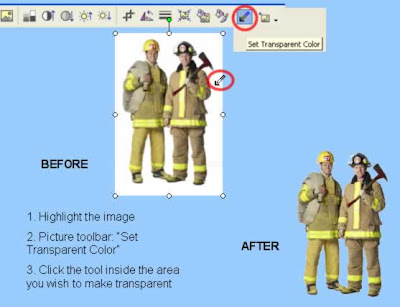
According to the Office Assistant: "You can create a transparent area in most pictures except in animated GIF. (Make these changes in an animated GIF editing program, and then insert the file again.)...The Set Transparent Color option is available for bitmap pictures that don't already have transparency information. It's also available for some, but not all, clip art." (Most of the art I use comes from clipart.com, and have had good luck with transparencies.)

According to the Office Assistant: "You can create a transparent area in most pictures except in animated GIF. (Make these changes in an animated GIF editing program, and then insert the file again.)...The Set Transparent Color option is available for bitmap pictures that don't already have transparency information. It's also available for some, but not all, clip art." (Most of the art I use comes from clipart.com, and have had good luck with transparencies.)
Sunday, March 16, 2008
Are you a technical communicator-type?
Are you a technical communicator? Lots of "application training"? User manuals? "Help" data?
I'm running the Instructional Design Institute for the Society for Technical Communications' annual Technical Communications Summit June 1-4 in Philadelphia. This is a big, fun event great for those who deal in technical communication and information (hint to those of you who do "app training"...)
Karl Kapp and Susan Boyd will be joining me for the ID Institute; we hope to see you there!
I'm running the Instructional Design Institute for the Society for Technical Communications' annual Technical Communications Summit June 1-4 in Philadelphia. This is a big, fun event great for those who deal in technical communication and information (hint to those of you who do "app training"...)
Karl Kapp and Susan Boyd will be joining me for the ID Institute; we hope to see you there!
Sunday, March 09, 2008
Using Game-Show Games to Replace Quizzes

Cathy Moore has been having a discussion about "shoestring" approaches, and among her suggestions are using, 1. photos of real people, and, 2. multiple choice questions recast as games. I give both of these ideas a lot of coverage in my books, but here's a quick example in practice.
Based on the "Hollywood Squares" game, this was developed for a new-hire orientation program both as a way to cover fairly dry content as well as helping staff recognize people they'd need to know to both "get around" and "get along" in the office. (I remember the morning one of our bright-eyed-bushy-tailed new employees encountered our agency head-- then Governor-Elect -- and greeted him with a hearty "Whassup!?")
The real program is proprietary but I dummied up a reasonable facsimile in PowerPoint this morning-- enough for you to get the idea. See E-Learning Solutions on a Shoestring and especially Better than Bullet Points for more ideas on using game-show game approaches to replace traditional methods of quizzing.
Wednesday, March 05, 2008
What does "LMS" mean to you?
Will Thalhimer has a recent post in which he discusses "LMS" as the "Learning Means Sitting" mentality, while Mark Oehlert once called it a "Lecture Management System".
What does "LMS" mean to you?
What does "LMS" mean to you?
Monday, February 25, 2008
Great E-Learning Tip 1: Develop a good treatment
 Want to make e-learning "better than bullet points"? Start by finding a way out of the static-content box and into an engaging treatment that invites application rather than regurgitation. Here, for example, are two ways of approaching an art history lesson. The first is the typical bullet-points approach; the second, an interactive mystery about a painting found in an attic. "A. Pintura: Art Detective" from Eduweb asks learners to evaluate, synthesize, and apply information rather than just memorize.
See the bozarthzone main site for more examples-- and please send links to any you happen to run across!
Composite image from "Better than Bullet Points". Image from A.Pintura: Art Detective used with permission of Eduweb.
Saturday, February 23, 2008
For my "E-learning Solutions on a Shoestring" readers

I have been accused of neglect! Mea culpa! Readers of my "E-Learning Solutions on a Shoestring" can check the bozarthzone for updates on e-learning addons, tools, and a recording of my presentation "Collaboration on a Shoestring: Using Web 2.0 technologies in Training". Don't own "Shoestring"? Amazon will gladly send a copy your way...
And while we're discussing mistreatment, let me also direct you to one of my favorite sites, Sue Palmer's Home for Abused Apostrophes.
And while we're discussing mistreatment, let me also direct you to one of my favorite sites, Sue Palmer's Home for Abused Apostrophes.
Wednesday, February 20, 2008
FREE! Online course: "ID for the SME"
I've been toying with the idea of developing an asynchronous "ID basics" course, and here Clive Shepherd has gone and created this, a gift for us all. It's a FREE online program, "The 60-Minute Masters: ID for the SME". Quick, clean, commonsense, and targeted correctly at the SMEs with whom many of us work.
It's available at http://www.kineolearning.com/60minutemasters/
It's available at http://www.kineolearning.com/60minutemasters/
Sunday, February 17, 2008
Virtual Worlds and Grammar Girl
The Illinois online conference was chock-full of interesting sessions and much fun, including "cocktail hours" in Second Life (on Squirrel Island, where my avatar got herself in trouble, as usual...) and a great keynote from Grammar Girl Mignon Fogarty. This was an excellent way to attend good informational sessions, many on cutting-edge technologies, as well as meet and network with new colleagues.
Here's a question I asked during Grammar Girl's session, when the participant talked turned to concerns about text messaging bringing about the downfall of good writing, spelling, civilization...:
Is text messaging meant to replace writing, or conversation?
Here's a question I asked during Grammar Girl's session, when the participant talked turned to concerns about text messaging bringing about the downfall of good writing, spelling, civilization...:
Is text messaging meant to replace writing, or conversation?
Wednesday, February 13, 2008
A Blog by Any Other Name
I just did my "Collaboration on a Shoestring" session for the Illinois Online Conference, where we talked about using Web 2.0 technologies for training purposes. I'm always interested in seeing how people repurpose these technologies in interesting ways and to suit varying needs. A local restaurant, Piedmont, is using a blog as a quick, easy-to-edit, free way of updating its daily menu. (The restaurant's good, too!)
What other unusual uses are out there for blogs, wikis, and other Web 2.0 tools?
What other unusual uses are out there for blogs, wikis, and other Web 2.0 tools?
Tuesday, February 12, 2008
A Proposal for Banning.... Pencils
I heard Anders Gronstedt speak at Training 2008. After a great presentation on Web 2.0 technologies, including a nice visit to Second Life, he wrapped up with a reference to "the Bureacrat Class". You know 'em: the ones in the organization who try to block anything marginally innovative. Finance says everything is "expensive", Legal says it's "too open", and of course IT says it's "too dangerous". (PS: Raise your hand if your organization is being held hostage by its own IT department.)
Meantime this week, in keeping with the same theme, I see that Karl Kapp has comments on schools disabling the very technologies students use most (to discuss education, even).
So for all of you who share the concern and pain of this, check out Doug Johnson's A Proposal for Banning Pencils .
Meantime this week, in keeping with the same theme, I see that Karl Kapp has comments on schools disabling the very technologies students use most (to discuss education, even).
So for all of you who share the concern and pain of this, check out Doug Johnson's A Proposal for Banning Pencils .
Sunday, February 10, 2008
When is design done?

This month's Big Question on the Learning Circuits blog is: "If, When, How Much?". To follow up on a follow-up question from Jay Cross, "When to stop designing?"
I'll add:
Design is done when there's nothing left to take out.
Illinois Online Conference on Teaching & Learning
I hope to see you at the Illinois Online conference. There are lots of sessions on using Web 2.0 and virtual worlds for training and education, a whole track called "using cool tools", and even some on-demand and virtual poster sessions. And no trips to the airport!
Tuesday, January 29, 2008
Coming to Training 2008?
Lots of famous training folks will be in Atlanta next week for Training 2008. I hope to see you at my "E-Learning on a Shoestring" session, to include material from Better than Bullet Points. Also be sure to look for workshops from Patti Shank, Karl Kapp, Jennifer Hofmann, Saul Carliner...
And this year marks the return of the fun "99-Second Presentations". With emcee Thiagi, I'll be joined by people like Lou Russell, Marc Rosenberg, Donald Kirkpatrick (yes, that Donald Kirkpatrick), and Ray Jiminez.
I'll be signing books on the Expo floor at noon on Tuesday, so if you're coming please be sure to look me up! Hope to see you there--
And this year marks the return of the fun "99-Second Presentations". With emcee Thiagi, I'll be joined by people like Lou Russell, Marc Rosenberg, Donald Kirkpatrick (yes, that Donald Kirkpatrick), and Ray Jiminez.
I'll be signing books on the Expo floor at noon on Tuesday, so if you're coming please be sure to look me up! Hope to see you there--
Monday, January 28, 2008
Top 100 FREE Tools for Learning
Last year Jane Hart of the Centre for Learning & Performance Technologies asked learning professionals to submit their recommendations for top training tools. She's configured the answers in several ways, including
Top 100 Free Training Tools.
Watch for the results of her 2008 poll!
Top 100 Free Training Tools.
Watch for the results of her 2008 poll!
Thursday, January 24, 2008
The problem with most e-learning # 471

So how often does this happen? A trainer or instructional designer comes up with a great idea for making online content engaging and interesting-- something better than bullet points-- and by the time management and marketing and the Policy Police get through with it it's turned back into a dry, cover-every-possible-contingency-CYA-and, yes, bullet-ridden mind-numbing, learning-less online presentation (not "training").
I've heard from people who've been told games are "too much fun", "we aren't allowed to have anything light", and my favorite, to the student who knocked it out of the park on his final project for one of my e-learning development courses, "It's too entertaining". HUH? Time to push past the fear and give something interesting a try for a change. Stand your ground!
"Death by Risk Aversion" image used under creative commons license: Kathy Sierra/Headrush.
Subscribe to:
Posts (Atom)


 Posts
Posts

