Tuesday, March 11, 2014
Managing Expectations of Social Tools
I find that many organizations have rather unrealistic expectations of what will happen when they move to employ social tools. See this month's Nuts & Bolts column for more: "Every member in an organization won’t participate equally. There will be noise. And some of that noise will end up having value, or building a bridge that will prove useful later. Just like in real life.”
Headed to Learning Solutions next week? I've got breakouts...stage presentations...a panel... and live #lrnchat! Hope to see you there.


Monday, February 10, 2014
Building Community
A lot of my time is spent hearing about, and talking about, and reading about, and endeavoring to, building communities. I find that people come to the conversations often too focused on the same things (mostly control, platforms, and, er, control) without much regard to desired outcomes, user experience, and dangers. See this month's Nuts and Bolts column for more.
Tuesday, October 01, 2013
Punish the Learner
For those who've been keeping up with Project Ukulele, I found a nice local group that has a uke playalong meetup every 1st and 3rd Monday. We meet in a small coffeehouse that hosts small concerts so there's something of a 'stage' up front. In months that have a 5th Monday -- like September 2013 -- there's an open mic meeting. People come prepared to perform a song or 2, and with the smaller group that shows up it's a fun time to share and learn some new songs.
Last night as we were winding down, and after a good deal of nudging from the man next to her, a woman named Vivian got up on stage. She's been playing for 2 1/2 weeks. Weeks. Before she began she said:
"I took piano lessons for a year when I was six. The night of my recital I walked out on stage in my beautiful blue satin gown my grandmother made for the occasion. We weren't allowed to have music; we were expected to play our pieces by heart. I sat down on the bench and started to play and then -- I couldn't remember what came next. I just froze. And I hung my head. And I remember now how it felt when I looked down and saw big teardrops falling down onto my beautiful new satin dress. I haven't touched an instrument since then."
She put some printed music on a stand, then played and sang a lovely rendition of Leonard Cohen's "Hallelujah".
In my work I run into a lot of "blame the learner" mentality: "They can't use the technology, and they don't want to learn, and they don't care, and no matter how many times we go over it they go back to work and do it wrong." And I recently read -- really -- "There are no learning problems in corporate settings. There are only people unwilling to learn."
I promise you no one wanted to learn more than 6 year old Vivian. But put a good performer in a bad system and the system will win every time.
Let's talk about Vivian. She was 6 years old and:
Was expected to perform.
Before she was ready.
In an unnatural setting.
In public.
With "bosses" watching.
By memory.
Without a job aid.
I suppose you get my point.
Last night Vivian was ready to try again. It wasn't quite this, but it wasn't bad at all. And it only took her 56 years.
Tuesday, September 17, 2013
Making Video More "Social"
Something new next week, hosted by KZO Innovations: Video used in formal training, or to support informal learning, doesn't have to be just another passive viewing experience. Too often online video becomes just another publish-only venture, but there are easy ways to make it more of a social and reflective endeavor. Join me for a look at the ways video can be used effectively to extend learning experieces and help generate new ones. September 26, 1:30 pm, free (note: 50 minutes). Sign up.
Monday, September 02, 2013
The Myth of Best Practices: Update
In 2009 I wrote a post, "The Myth of Best Practices" , that described problems with both context and fidelity. Here's a great example of what usually happens when "best practices" are transferred from one setting to another:


Wednesday, August 28, 2013
Be A Learner
This month's "Nuts and Bolts" column explores the ways an instructional designer can learn from her own learning. In my line of work there’s a lot of conversation about instructional design and common design flaws, and I spend a lot of time evaluating eLearning courses and products. I find it helps my perspective immensely when I set out to learn something new for myself, the more unrelated to work, the better. Among them: Play the song, draw a picture, and lose the ferrets.
See more at http://www.learningsolutionsmag.com/articles/1218/nuts-and-bolts-instructional-design-101be-a-learner .
Tuesday, June 11, 2013
"Show Your Work" Event Today

I publish a lot, and few things have gotten me more response than last August's Nuts & Bolts column, "Narrating Our Work". It clearly resonated with readers, so much so that strangers now contact me wanting to share their own examples. (I am always interested in seeing more, by the way.)
As I wrote in the May issue of T+D Magazine:
" Sharing and showing what we’re doing and learning can ease several pain points for organizations. First there’s the capture of tacit knowledge: it helps fill the gap that so often occurs when someone leaves a job but those remaining don’t know how to pick up where the former worker left off. And it helps others learn about executing work not easily captured as a step-by-step process. Then there’s the matter of connecting talent pools, branching across organizational silos, and surfacing expertise. How many times have you finished a project , or researched an idea, or hunted down a resource, only to find someone else had already done the same thing? For T & D, a willingness to learn from what workers share can help to reveal where training issues exist, provide artifacts that can be repurposed as training content, and help make workplace training more relevant and real-world based. And: showing what we’re doing -- narrating our work in a public way -- work helps make learning more explicit. It surfaces informal and social learning to help make it visible to the organization and and management, whereas often now it is only opaque."
" Sharing and showing what we’re doing and learning can ease several pain points for organizations. First there’s the capture of tacit knowledge: it helps fill the gap that so often occurs when someone leaves a job but those remaining don’t know how to pick up where the former worker left off. And it helps others learn about executing work not easily captured as a step-by-step process. Then there’s the matter of connecting talent pools, branching across organizational silos, and surfacing expertise. How many times have you finished a project , or researched an idea, or hunted down a resource, only to find someone else had already done the same thing? For T & D, a willingness to learn from what workers share can help to reveal where training issues exist, provide artifacts that can be repurposed as training content, and help make workplace training more relevant and real-world based. And: showing what we’re doing -- narrating our work in a public way -- work helps make learning more explicit. It surfaces informal and social learning to help make it visible to the organization and and management, whereas often now it is only opaque."
Curious? Here's a Pinterest board that should give you an idea of the kinds of things we'll discuss today.
Friday, May 24, 2013
Are You a Positive Deviant? (Updated June 1)
Update: I curated some resources for webinar attendees that others may find interesting. Due to the buzz this topic generated we're continuing the conversation in #lrnchat on Thursday, June 6, 8:30 pm ET, 5:30 PT. (Sydney? That's Friday June 7, 11:30 am.)
"In every group there are a minority of people who find better solutions to the challenges at hand…even though they have access to exactly the same resources as the rest of the group, their uncommon practices or behaviors allow them to flourish.”—Jerry Sternin
You know one: the one manager of 30 in the building who never misses deadlines and consistently shows good results while retaining great staff. The one teacher who’s successful with technology integration, while 50 others don’t “have time.” The one state government classroom trainer of 500 who instead of saying, “We can’t do e-learning because it’s too expensive,” asked, “How can we do e-learning without much money?”
Read the rest in this month's issue of Training Magazine.And view the recording of the May 29 webinar (Training Magazine Network) "Tips for the Positive Deviant" .
Thursday, April 04, 2013
Want Better Outcomes? Design Assessments First
New Learning Solutions column this week: “Work backwards. Write the performance goals, decide how you will assess those, and then design the program. The content and activities you create should support eventual achievement of those goals.”ork b
See the full article at:
http://www.learningsolutionsmag.com/articles/1146/nuts-and-bolts-design-assessments-first
Sunday, March 31, 2013
What is "Good" eLearning, Anyway?
This month in Learning Solutions:
"Over the years I’ve seen a lot of lists of criteria for buying eLearning, for developing a product, and for choosing a vendor or developer. I agree we have to go in having some idea of what ‘good’ is, at least enough to keep us away from all text or bedtime-reading narration of that text, or seductive but irrelevant elements. The trick? Finding an explicit performance need, getting clear on assessments first, and sticking to a plan that helps the learner learn.”
See more at:
http://www.learningsolutionsmag.com/articles/1115/nuts-and-bolts-what-is-good-elearning-anyway
"Over the years I’ve seen a lot of lists of criteria for buying eLearning, for developing a product, and for choosing a vendor or developer. I agree we have to go in having some idea of what ‘good’ is, at least enough to keep us away from all text or bedtime-reading narration of that text, or seductive but irrelevant elements. The trick? Finding an explicit performance need, getting clear on assessments first, and sticking to a plan that helps the learner learn.”
http://www.learningsolutionsmag.com/articles/1115/nuts-and-bolts-what-is-good-elearning-anyway
Sunday, March 03, 2013
PowerPoint Converter for 2013
With the 2nd edition of Better Than Bullet Points: Creating Engaging eLearning with PowerPoint (updated for PowerPoint 2013) going to
press in August I’ve been busy learning PowerPoint 2013 and testing out
converter tools. [Disclosure: I made it known that I was working on this. Some vendors approached me asking me to test tools; I downloaded some free trials of others.] What I’ve always needed? Quick conversion, quick upload with
minimal bugs, and fidelity in capturing audio, transitions and animations,
including triggers. What I need now? All
of that, compatible with PowerPoint 2013, and with reliable conversion to both
Flash and HTML5. And, with Microsoft’s unfortunate
decision to take the Sound Editor out of Windows, I hoped for a product that
included an audio editor, thereby keeping me to just two tools (PowerPoint and
the converter tool) rather than three or more.
I looked at several products and found overall I was very
happy with the iSpring Suite 6.2 and still-in-beta iSpring Pro 7. http://www.ispringsolutions.com
. I gave it quite a workout and
consistently got the fast, smooth conversions I was after without once having
to go play with manifest files or otherwise do any debugging. Conversion of even big slide shows with lots
of images, animation and audio is very fast. I don’t make heavy use of video
but did try conversions with several video clips in assorted formats and got
good results. Here's the iSpring Suite toolbar:

The player is highly customizable. I never need 1/10 of what most products offer so it did everything I wanted although I admit
to not pushing it very hard. I especially liked the ease of making choices: unlike some other products, there aren’t a lot
of default settings that are difficult to override.

Publishing is a one-click to web, cd or LMS, and everything ran the first time, every time. I was pleased with the audio recording and editing tools and allow that it is much better than the minimal functiontonality provided by the old Windows Sound Editor.
While I’m not looking for much in the way of “authoring”
outside of PowerPoint itself, the iSpring suite includes the Quizmaker and the
Kinetics interaction tools so I did take them for a spin. The Quizmaker provides options to create
graded items such as multiple choice, matching, hotspot, and even text entry, or ungraded
survey-style quizzes. The Kinetics tool
is limited but offers a few interactions, such as one for creating a
page-flip appearance, a FAQs creator, and a nice little timeline builder
(period, event, that sort of thing) that
would be tedious to build from scratch in PowerPoint.
Overall: The product behaves well, did what I need without
compromise or workaround, and had no performance problems during testing. There are a few
animations not yet working with PowerPoint 2013 but they are expected in an
upcoming update. I’m not one to often endorse products but, along with my
undying love for SnagIt, can say iSpring is worth a look. There’s a free trial for iSpring 6.2, but I’m
bringing this conversation up now because iSpring Pro 7 is currently in beta and available to those wishing to serve as
testers. See http://www.ispringsolutions.com/ispring-pro-7.
Monday, February 04, 2013
When Social Biz Meets Superbowl
I spend a lot of my time describing effective use of social media and the need for brands to have a real voice, to show that they are in touch with their customers, and to show that they are acting in real-time. Problems with auto-scheduling and then stepping away from social media content, or outsourcing social media tasks to inept firms, have time and again proven embarrassing (at best) for companies. But it's no reason to shy away from working in the social space.
Last night's power failure during the Superbowl brought several great examples of corporate social media voices in the right place at the right time, giving a bit of humanity to the companies and showing some personality behind the corporate image:


As with most anything else at work, it's a matter of hiring. Choose those who will understand and bring the right voice at the right time, who show a sense of humor and confidence in doing the right thing for the organization. And let them work.
Saturday, January 05, 2013
Happy New Year
It's my habit with each January column to revisit colums from the previous year. Here's a recap of major themes from 2012:
1. Find new approaches to design work
2. Be more reflective about practice, and work to evolve it
3. Find new ways to encourage change by showing value
The full piece is at:
http://www.learningsolutionsmag.com/articles/1082/nuts-and-bolts-happy-new-year-2013
Tuesday, December 04, 2012
Content Becomes Its Own Context

More: http://www.learningsolutionsmag.com/articles/1070/nuts-and-bolts-content-becomes-its-own-context
Tuesday, November 06, 2012
Metaphors
"How would different beliefs about learning affect our practice? What is the prevailing belief in your own work culture? In thinking of my own past and present workplaces, and the types of instruction I’ve most often been asked to build or facilitate, the belief seems most often to be that learning happens as people acquire discrete pieces of data—which we hope they’ll apply as needed. This in turn affects the way in which the instruction attempts to tap into prior learning and tie to other, related pieces of instruction."
For the full article, see: http://www.learningsolutionsmag.com/articles/1054/nuts-and-bolts-metaphors
The Pinterest board referenced in the article is at http://pinterest.com/janebozarth/learning-teaching-metaphors/
Tuesday, October 02, 2012
Assessing the Value of Online Interactions
In looking for value in online interactions, try to get past the idea of a magic metric. I can’t tell you that my spending x hours on LinkedIn and tweeting y times per day will get you the result I got in the example above. I can tell you that my choice of when, with whom, and how to engage is what helped drive that result.
For more, including an overview of a new framework from Wenger et al, see:
http://www.learningsolutionsmag.com/articles/1019/nuts-and-bolts-assessing-the-value-of-online-interactions
Tuesday, September 04, 2012
Unlearning
One of the givens in working with adult learners is the importance of helping them access prior knowledge and building on what they already know. But what if that prior knowledge is no longer useful, or the skills no longer applicable, or it was never very accurate in the first place?
See more in this month's "Nuts and Bolts" column: http://www.learningsolutionsmag.com/articles/1000/nuts-and-bolts-unlearning
Wednesday, August 15, 2012
Narrating Our Work
"By sharing what we are doing and how we are learning, we distribute the tacit knowledge otherwise so hard to capture; invite feedback and encouragement from others; invite others to learn with us; document our work and learning for future use; and tie our learning to the efforts of others. Here’s a true story about physical rehab turned learning turned hobby turned community of practice turned two successful businesses, all via informal, social means. And all within six months."
See this month's "Nuts & Bolts" column: http://www.learningsolutionmag.com/articles/984/nuts-and-bolts-narrating-our-work
UPDATE 2026. In a server move the new owners of the Learning Guild deleted a good deal of old content. That column no longer exists. Luckily I still have all my files.
See this month's "Nuts & Bolts" column: http://www.learningsolutionmag.com/articles/984/nuts-and-bolts-narrating-our-work
UPDATE 2026. In a server move the new owners of the Learning Guild deleted a good deal of old content. That column no longer exists. Luckily I still have all my files.
[Leader Here’s a
true story about physical rehab turned learning turned hobby turned community
of practice turned 2 successful
businesses, all via informal, social means.
And all within 6 months.]
Narrating Our Work
There’s a lot of talk among the
social/informal/curation-interested learning set, of which I hope I’m
considered an active member, about the idea of narrating our work. This has
become decidedly easier over the last decade given the many new tools available
for it. By sharing what we are doing and how we are learning, we: distribute the tacit knowledge otherwise so
hard to capture; invite feedback and encouragement from others; invite others
to learn with us; document our work and learning for future use; and tie our
learning to the efforts of others. Here’s a true story about physical rehab
turned learning turned hobby turned community of practice turned 2 successful businesses, all via
informal, social means. And all within 6
months.
Self-directed
informal and social learning. I have an acquaintance from my hometown,
Gloria Melton Mercer, who became a Facebook friend some time back. Gloria, a retired
elementary school art teacher, needed surgery on her dominant hand in October 2011
and was told she’d need to find a way to rebuild her strength and dexterity. Thinking,
“You should mix something fun with something you need to do, right?” she
decided to teach herself to create elaborately decorated bakery-style cookies (learner identifying own needs; taking
ownership of learning; choosing own solutions). Gloria started with YouTube videos, many
provided by bloggers whose work she then followed (self-directed learning). A
lot of her learning was through practice and trial-and-error (experiential learning). And along the
way she decided to share her project with her Facebook friends (because that camera on her phone is really
easy to use; Facebook makes things so easy to post; she wanted to solicit
feedback; she thought it might be fun
to share her work; she had learned from
others who shared theirs). Many
photos included comments about what she was learning, and how (narrating her work and learning out loud).
A community of practice (CoP). Then: As Gloria became familiar with the videos and
blogs, she developed a growing awareness of an existing active community of
people with similar interests. She began engaging with some of the bloggers,
asking questions and sharing her own answers.
Gloria’s daughter Marlo and Gloria’s friend Whitney, seeing Gloria’s
creations on Facebook, decided they wanted to learn, too. Soon they
started sharing what they were learning; all were participating with the
explicit mutual goal of getting better at their new craft (per Etienne Wenger, this
is the very definition of a community of
practice). As they worked they emerged
as contributing members of a true community of practice, with production of artifacts (recipes, actual
cookies, and pictures of them), a repertoire (libraries of cutters and
techniques mastered, like cartoon characters and airbrushing, and a specialized
vocabulary with meaning mostly for other cookie bakers). The repertoire
included another classic mark of community, members developing own in-jokes and
references. As they went along the rest
of us watched, encouraged, suggested cookie ideas, and commented . Eventually Gloria became a full participating
CoP member as she began teaching others.
Real Application to a
Real Workplace. Now? Gloria continues to work on her technique, but cookies
remain for her only a hobby. Marlo started and operates Coastline Cookies in Midlothian
VA, USA. Whitney started and operates Beach House Cookies in Virginia Beach VA,
USA. The “roi” of this informal, social
learning experience? I guess you’d need to ask Marlo and Maria to hand over
their books. They have businesses where before they had none, and they both
report operating at a profit only a few months in.
Here’s how it looked:
October
2011-January 2012: Gloria learns basics from YouTube videos, then finds that
many of those posting videos also have blogs and Facebook pages. “I found a company called Karen's
Cookies that showed how to make cookies and decorate them. I figured she would
give me correct information if she wanted people to buy their supplies from her
(evaluating credibility of information).
Karen’s Cookies site posts some of her favorite blogs. Many of the bloggers
also have Facebook pages. I made a special Facebook list for these, so I can
watch each day to see the latest cookies.” In January Gloria begins
posting pictures of her early efforts, which she called “trash”, but reports
that where cookies are involved, even hungry husbands like “trash”.
Figure 1: January 3, 2012, making trash

Figure 2: January 10. Cookies are no longer “trash”. Gloria
offers comments about her learning.

Figure 3. January 13: Gloria’s feeling confident enough to make cookies for family gifts.

Figure 4. January 18. Gloria says she still can’t make her hand and icing “do what she wants.” Gloria’s daughter Marlo, 125 miles away, joins in, as does Gloria’s friend Whitney. Gloria describes the need to “stop and stand back” when learning to decorate.

Figure 5. February 2012: Marlo and her husband Mike begin taking orders for cookies. Marlo obtains a business license and Coastline Cookies is born. Marlo says: “After the experience with the Valentine’s Day cookies Mom and I were both hooked. We would spend hours out of our day watching videos and reading blogs and calling each other to share what we had learned. We still do!”

Figure 6. Gloria tries her hand at using the airbrush.

Figure 7: April 2012: Gloria is turning out gorgeous cookies by the
dozen.
Figure 8. Gloria begins teaching others.

May 2012: Marlo learns
web design so she can launch and manage the Coastline Cookies site http://www.coastlinecookies.com/
Figure 9. July 2012. Marlo’s Coastline Cookies company is already a huge success.

Figure 10. July 2012. Whitney’s Beachhouse Cookies is likewise doing well http://www.beachhousecookies.com/index.html

And Gloria continues to learn new techniques and share as
she goes, while the rest of us remain on the lookout for new, interesting cookie cutters. Her new special interest is in learning
better ways of photographing her final product.
Figure 11. Gloria moves on to learning about heat guns, quilting, and cookie photography.

There are so many lessons to be gleaned from this case: The social aspect of publishing your learning,
getting feedback and encouragement from friends, and helping other friends as
they learn; the fact that enthusiasm can
be contagious; the willingness to share and not keep everything to yourself;
the real way that knowledge is shared; the organic ways that networks grow.
And more to be learned here: that learning often spawns the desire for
additional learning (like web design and photography); the futility believing we can ‘capture’ knowledge as discrete pieces
of data in a spreadsheet; that ‘generations’ has nothing to do with anything;
the ways in which social technologies can accelerate learning and give it
geographic reach; and the value of a community truly committed to improving
practice.
This is social
learning. This is informal learning. This is narrating our work.
So the concluding question: For Gloria this was a hobby, but
for Marlo and Whitney it has become full-time employment. How can we encourage
others to narrate their work? What
support or tools would enable that? How
about the repair technician who figures out a new, quicker workaround? Or the
restaurant chef who develops a new technique? Or the software engineer who…? Or
the paralegal who….? What opportunities are we missing?
Tuesday, May 01, 2012
"Selling It": Encouraging Change
This month's "Nuts and Bolts" column takes on a common problem: sometimes in our enthusiasm we may be creating the very resistance we're trying to overcome. "What we find cool, others find intimidating. What we find useful, others find threatening. What we find magical, others find scary. And sometimes the very benefits we tout are exactly what others fear."
Wednesday, April 18, 2012
Blog Book Tour: Karl Kapp's "Gamification of Learning and Instruction"
Blog book tour stop 3: I was lucky enough to get my hands on an advance copy of Karl Kapp’s new book, “The Gamification of Learning and Instruction” (Pfeiffer) (also see the book's Facebook Page) just in time for a long plane ride. What a delight! In an age when there’s so much confusion about this in the field, Kapp offers a timely, common-sense view of realities and possibilities. Among my own frustrations are those in L&D (and, ahem, marketing) who are swept away on tides of badges and points without really understanding the instrinsic motivation and factors critical to successful, meaningful gamification. (More about that? Take a look at the incredibly popular new game Draw Something, in which the only "rule" is an implicit one and successful play requires collaboration, not competition. Fifty million downloads within 50 days of release. And there isn’t even a winner, ever. )
Kapp pitches the book at just the right level, making material relevant for more experienced gamers as well as for those to whom all this would be rather new. Several chapters offer basics about game elements and play, while others offer reviews of theory and research regarding games for learning, player types and patterns, and snapshots of ways games can support workplace performance of particular types of tasks. Chapters open with questions, which provides a nice advance organizer for the information to come.
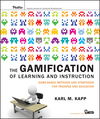 The author has called in some big guns in terms of expertise, with Alicia Sanchez providing a chapter-length case study from Defense Acquisition University, and a chapter on virtual reality games from expert Koreen Olbrish. I love that Chapter 11 is written by high school senior Nathan Kapp, the author’s son, who brings a particularly relevant perspective as he “has been playing video games his whole life."
This is an excellent resource for those seeking to make sense of the gamification craze and apply gamification principles to create better learning experiences.
Subscribe to:
Posts (Atom)


 Posts

